Showing posts with label travel. Show all posts

Friday, October 11, 2013

Oh, sure - the Zurich pics!


Happy Friday! Enjoy the pics from Zurich.

Lake Zurich, aka, Zurichsee.


Swans all over the lake.


After that long hot shower, and podcast, my meal. A 4 ounce glass of wine, a pretzel, and a salad buffet. Beets. Arugula. Apples. Peppers. And a little pasta, a little meat.


The rivers running to the lake... a city of bridges, like my own.


One rainstorm for about 45 minutes, and the rest of the time was postcard-perfect.


Famous Grossmunster Church.


I wanted to eat at every little tucked-away place. 


Middle of the city, crossing a bridge from Hallwylplatz into the financial district.


An art installation of enormous tapestries. There was a metaphor in there for me about the laundry drying in the third world providing art in the first.


Dinner. 4 dl of wine (about 13 ounces), meat, cheese, apples, tomatoes, pickles, figs, nuts.


On a boat, on Zurichsee. 


You sort of have to. It's Swiss chocolate. 

Thursday, October 10, 2013

Tanzania: Epilogue

The last night's dinner was lovely - three of us were leaving, and eleven were staying another week. The three of going said a few words to each other volunteer, and then the eleven said something to us three.

Turns out, I was appreciated mainly for being sarcastic, and funny, and calling shit "shit" when it was needed. I was also given what I think of as a blessing... told that Meggie and I are seekers, and for seekers, the journey and the experience are often the whole purpose, not the destination. I was admired for being in a marriage that "allowed" me to travel alone, to complete my heart's calling, that it was ok it was not John's heart's calling. Meggie and I were solemnly toasted as a model of a beautiful friendship, a model others said they're going to strive to emulate.

We were up in the dark Friday morning - but Mamatony was too, with a little green onion omelette and toast for our journey. This time, we drove all the way to Dar in one push - stopping only for lunch, and for more "surprise!" experiences with public toilets. (You never know what you're going to get, but I learned one thing - check the faucet first, see if there's running water. It's just good to know before you see what the stall has to offer.)

We got to Dar in the dark, and went to one of those food-court strip-mall places that you see and read about it in the developing world. Attached or near a shopping mall, they're bad food in a safe setting, they're places the middle class socializes with itself, and shows off as members of the middle class. Meggie and I had burgers - she had beef, but I wasn't quite ready to let go of the flavors of coastal Tanzania, and had a chicken tikka masala burger. I tried to get a photo of the sign across the street - we make fun in America of "any excuse for a sale" but this was pretty well on par:


(That's "Pay only 80% during Eid!" I think 20% off is smarter than pay 80%, but there must be a learning curve up to American standards of marketing.)

We stayed at the same hotel from two weeks earlier; this time, we comfortably strolled around the market area, got an ice cream, had a glass of wine at the oceanfront restaurant and felt perfectly at ease with the currency, the people, the music. This time we knew to expect a Ramadan party all night, and put in ear plugs. And oh - the shower. The long, hot shower. To be honest, I showered first, and Meggie said, "How'd it feel!?" And I said, "Just OK. That shower was getting the grime off. Tomorrow's shower will be one I can enjoy."

(Me after 6 days without even attempting a hair wash, and just a couple half-bag half-warm sun showers from the safari in Ruaha, up through the last week. My hair was so fantastically matted, I could shape it into any style.)


The next day was Saturday, and all flights leave Dar for Europe at night - so we spent the day shopping, buying trinkets and thank you gifts for our supporters, trying some candy and Saudi Arabian dates. We learned a new tradition from a volunteer... when people leave, don't wave. Don't say goodbye. Dance them off, and then you can dance them home again when they return. So we danced off the first of us to leave (she sent this ridiculous picture later, and note I am still snug as a bug in a rug in my hiking boots:)


And then we went for an early dinner. Note the Sprite - I'm considering it medicine still, at this point.


And after a long, dusty trip to the airport, after buying Cuban cigars for John at the duty-free, we got to our waiting area at the airport - where the plane was late, there were no updates announced, and only Meggie's French managed to get us an explanation from the Swiss Air steward! We took off about an hour late, first for Nairobi and then for Zurich. One last photo at the airport....


And then we slept - sort of - but flew in relative silence. The guy in front of us puked the whole flight. The woman in the aisle over had malaria and was cutting her trip short.

Arriving in Zurich, our lateness meant Meggie had to run to catch her plane to Paris. I was to have my two nights in Zurich... and realized I had no idea how to get to my hotel, where it was in the city's districts (beyond an address), or how to use public transit. We squeezed hands and I shrugged and laughed, "I 'm sure I can figure it out!" Calmest I've ever been. I mean, there were clean toilets and drinking fountains I could use. How bad could it be? Meggie provided me with a few French phrases to use, and I wandered through customs (they thought it was very odd that I was staying in Zurich under 48 hours) and then up to an information booth. I got some Swiss Francs, I brushed my teeth, and I left the airport, determined not to take a taxi but to figure out the buses and trains, to get to Hotel St. Georges on my own, and ate my very last nutrition bar. 

It took three hours to do it - and should have taken about 40 minutes - but I got there. Zurich on a Sunday morning, with the church bells vibrating my skull, and hardly a person out, with all the shops closed, was as other-wordly as a Tanzanian dirt path. My room was miraculously ready for an early check-in. I opened my third floor window. I looked out on this:


I took a long, long shower and put on a podcast of The Splendid Table. Then I headed out to see Lake Zurich with the Sunday revelers. 

It's all in the journey. 


Wednesday, October 9, 2013

Last Night in Pommern, August 1.


(As written in my journal that day; grammar and minor edits only. Italicized portions are additions written after the trip.)

I'm sitting watching the sun set, and thinking how I wanted to feel the air and see the light in Africa - would it be so different? 

Yes and no. It reminds me of remote Montana or Canada in clarity and vividness - and yet there is something different. There's a heightened sense of isolation, of danger. Like, something bad happens out here and sister, you're on your own. That gives it excitement - but a wary edginess I can't shake, no matter what time of day, no matter whether I'm outside or in the mission house. 

Maybe Maslow's layer of security makes us soft Americans, but displaying a tender heart is what Pema counsels us to have. Is poverty different in a Buddhist society? Although, things that are part of society here are not stolen - our iPods would be, but that neither the pile outside the clinic nor the bikes, bricks or lumber we see outside the Lutheran church for days are. So perhaps this is as peaceful a place - minus teachers with sticks, of course!! - as it can get. Or is it a detente of sorts? A recognition that you don't take bread out of a hungry man's mouth, even you're starving too - even if you're starving more. 

I've also been thinking today, after the clinic experience, about my possessions - things here, like the little nail clippers I brought and just used, that work so perfectly for their one exact use - and things awaiting me at home, like the exact right clothing for a mood, for the weather, for a celebration or mourning at hand. And people told me, and I expected, to think of my possessions with awe at how much, too much, I have. But you know what? I don't think that.

I think... I'm so grateful to have what I do, and I have long been trying to value it all by only keeping things I love. I already work to implement rules. No continuing to wear something I don't feel great in. No more decor pieces I used to like, or was given as a gift and I feel too guilty to give to Salvation Army. No extras - we currently have only one set of sheets, a half dozen towels, no good china (just one set of dishes I like and use daily), no more clothes than can all fit into my closet at any one, single time (a full ban on seasonal wear that cycles in and out of storage!). 

So I look around here at people who own so little and I don't feel guilty for what I have because I'm not unconscious about it. It's not wrong to possess an item because it brings joy or beauty or function or ease to my life. It is wrong, maybe, to possess an item I don't use, like, or enjoy. 

So it hits me. I expected to discover totally new things on this trip - new realizations, thoughts, conclusions about human nature and history and spiritual life, revelations about the rest of my own life! But - that has - I think - universally not occurred.

Instead, all the revelations - the aha moments - and experiences and ideas here are connected to current ones. I see the through-lines of my own growth and spiritual maturation. What brought me here continues to be experienced here, and will continue when I get home. Everywhere I go, there I am. There's nothing new under the sun, or even inside me. All of the learning, here, is part of what I already wanted out of life, what I already seek - giving up control in order to be freer, calmer, more loving and compassionate and kind. Giving up rigidity in order to experience joy and surprise, to be present in the moment with gratitude. And, I sigh as I write this. It's so fucking hard. 

I stop short here of saying "be happier" though because I don't pursue happiness, as a general rule. I don't use happiness as a yardstick to measure much of anything. I use novelty, excitement, especially accomplishment and completion, to judge success. When those line up, happiness probably follows. But I'm a terrible judge of putting happiness first - usually, I end up overeating, over drinking, oversleeping or oversharing, and the thing that was supposed to make me happy makes me bloated, tired, embarrassed or hung over. 

Far better to use the other yardsticks, and far better to keep a continued, and ever-honed, sharp eye on my possessions as a tool to ensure this feeling of value, appreciation... real gratitude even in material things... is not at all out of place. 

Tuesday, October 8, 2013

August 1: Last full day in Pommern.


(As written in my journal that day; grammar and minor edits only. Italicized portions are additions written after the trip.)

It's CTC day - and through Meggie's excellent manipulative conversation skill with Edward, she's gotten me out and about, assigned alone to the Clinic, and herself over to the primary school - where she has wanted to volunteer since we arrived. 

CTC means Counseling and Test Centres - the HIV/AIDS clinic that serves seven villages, including Pommern. My energy is too low to do justice in describing the inefficiency with which 62 AIDS patients were seen today, at this monthly clinic. It is actually every Thursday, but each patient is on a monthly rotation - first Thursday, second Thursday, etc. They get ARVs or other drugs. And it wasn't the plain, pitiable, understandable inefficiency of no shelves, drawers, computerized lists of patients, or drug inventory. It went far beyond that and I want to do it justice when I have the patience to walk through it in each excruciating detail. 

After a long morning of work, and a late lunch, Meggie and I said our goodbyes to the tech and athletics team at the secondary school, who made Zumba possible, Adrian and Flavian. And then to Nurse Patricia. Meggie's totally hellish morning in the primary school has moved her to an interesting place - from guilt or pity to frustration that people are not helping themselves. I remember my brother being there, then in another phase of compassion, and finally he moved into a sort of Zen acceptance. Acceptance by attrition, maybe!

To try to do this description justice... first you have to imagine a cold morning, and the cement clinic. People "line up" to be "checked in". I use quotes because they sort of stand or sit around, near the door to the children's ward - no kids here today, so apparently it will be the CTC clinic. Every person has already waited outside on the far side of the clinic - the shaded, coldest area - to be tested (I can't see this happening; is it a blood test? A weight on the scale? Something else?) and given a number on a scrap of paper. Then they mill over to the yard in the sunshine, in front of the children's ward, where I sit at a table with another huge bound book in front of me. 

The nurses bark, "Next! Next!" and snap fingers at each patient to hand over their CTC card. They shuffle in, sit down, hand the nurse their card and slip of paper. (Or they don't, appearing as if they've never done this before. The nurse snaps for the scrap of paper, then, too.) A CTC card is a battered piece of card stock bearing their name, village, CTC number (it's a national registry) and instructions on when their clinic meets (what week of the month, what location).

This second line I'm helping with is to create a hard copy record of who showed up today, and whether they'll be getting ARVs or not. So I write their CTC number down, reading it from the card, and then the nurse tells me their village and their age, to fill in the next two lines. The age is asked for (why is it not on the CTC card!?) and if the person does not know, it is guessed at. Then their mystery number is written down and by science I don't understand, I'm told whether to check "ARV" or "No ARV" on the sheet of paper. 

The person is sent out, back into the yard, to mill around in a large group. No order is kept. 

We get through all 62, recorded in the book - the youngest patient is 9, the oldest is 72 - and most are female. The average patient is a woman in her 30s or 40s.

The young man diagnosed on Monday, in front of me and Meggie? He was in the line.

Then, everyone - the nurses, me, all the CTC patients - are herded to the very front part of the clinic yard. We spread out on the ground and on the few benches, sitting just in front of all the junk that's been mysterious to me since we arrived (rusted bed frames, broken old-fashioned wheelchairs, rotted boards, smashed bookshelves), not just for the content, but also because I look at it every day and wonder, in a village with so little, what is the social contract that prevents any item from being stolen? These are not useful wheelchairs or good boards - but surely someone could repurpose them and get great value. However, that sort of theft seems to be neither considered nor allowed; the village rules are clear and illustrated to me, if definitely unspoken.

What we attend, I start to understand, is a lecture on the importance of treating HIV and AIDS. Taking medicine, getting partners and family members tested, and then the longest segment on how it is possible to give birth AND breastfeed, without passing the disease to the baby. There is a young mother, who has AIDS, nursing her baby, and she seems to be telling everyone the baby is regularly tested but is negative, since she is taking her drugs and taking care of herself (she mimes eating food). The lecturers are Nurse Nema and Doctor Elton - and it's not fair that I am hard on Dr. Elton; I mean, yes, he's a dentist, and so that's an easy thing to point at and tease - but he's probably had enough clinical experience to push himself right into internal medicine, right?! 

The lecture is about 30 minutes long - and I'm glad for a seated break, I won't lie. Plus the sunshine warming me a little; it is another cold morning (though the sun is back out today, after being hidden by clouds and drizzle for both days I was home sick). 

Then, all the patients form another half-assed line, and I go back into the children's ward with the nurses. We sit at a table with boxes of drugs, and each person comes in with an old pill bottle. They show the kind they've been taking for a month, and are given a new bottle of the same kind. They also might have a scrap of paper with other prescriptions written on them - usually antibiotics, ibuprofen. 

The people getting ARVs are shit out of luck today; there are none. I'm told the government didn't supply them. No nurse appears to explain whether they should come back next week, out of their usual rotation, or what they should do for a month, being out of pills and all. In my head, I'm screaming, "Of course there is a contingent of Africans who think AIDS drugs don't work and that Americans and Brits are just poisoning their minds! The drugs DON'T work if you don't take them properly!"

A couple people don't have their old pill bottles anymore. We spend 15 or 20 minutes trying to decide what to do. We have to give them what they are used to taking - how can we possibly know if they don't have the old bottle, nor can remember? (There are two choices, friends, of pills to take. Two.)

Nurse Patricia leaves for 20 minutes by my count, with no reason, and comes back so we can pick up again with distributing. While she was out, the other nurses chatted on their phones. The line just stopped outside our door. Meggie said later she saw Patricia having a Coke and a snack at the little coke stand. 

These other drugs are available, for those not getting ARVs - getting what I think is a simpler protease inhibitor combination pill. And hey, they don't send the CTC ARV patients away empty handed... they all get vitamin B12 pills! That'll cure your AIDS.

Charting & Pill Dispensing:


I stay at the Clinic until about 1:30 PM. So in 5 hours, we've made people line up three times. Once to get their number determining ARVs or no. Another time to get registered at attending the clinic, in the big useless book. Then they attend a lecture - and all I can think is, is this something required by USAID or the Tanzanian government, and is the same lecture every week? - and we've made them line up AGAIN to get handed the right pills. When I leave, 9 of the 62 have their pills. It takes until about 4 PM to get all 62 through the lines and process here.

It appears as if this is the first time such a clinic has happened - and we know that's not true. We know this happens Every Single Thursday

Why line up three times? Why not see one patient at a time? Why not have pills counted out in a 30-day's supply, instead of waiting to count them out for each person? Why ask their age each time - why not ask them to be ready to supply it? Why record the check-in process in one large useless book, and then record who gets what drugs in a SECOND large useless book? 

And the best part? The second book records only what was prescribed. ARVs? Check. They were prescribed. The fact that they're not fucking available is not recorded anywhere. Check the books, and all looks well. This is Tanzania. 

So - I'm writing this so long after the actual day, I know I've forgotten some details of all the other tiny inefficiencies I witnessed. And as frustrating as it was - and, oh, lordy, it was! - in the middle of it, I sat there, patiently, for hours, waiting for bursts of activity, waiting to be told to record certain data, and generally not trying or wanting to tell anyone what to do. I just took it all in, and with the exception on the one mental scream above, I felt useful in recording the data - because it was something. It was freeing up a nurse's set of hands to actually chat with patients, and touch their shoulders, and look into their eyes. But for me to not want to tell someone what to do, how to do it faster, better, more efficiently... well, that's basically an African miracle! 

Monday, October 7, 2013

July 31 in Pommern.

(As written in my journal that day; grammar and minor edits only. Italicized portions are additions written after the trip.)

At breakfast, Edward tells me I'm not allowed to work today. "One more day to rest. You don't leave the mission house this morning."

I'm so disappointed. To lose a second day!? Nearly my last?! But within thirty minutes of breakfast - one plain slice of bread (so oddly sweet, I need some sourdough up in here!) and 1/3 of a banana - I find I'm ready for a nap. So perhaps Edward knows best - and perhaps he's been through this before with a previous volunteer (ha, ha, ha - that's a joke; I know he has).

So today I find stillness, whether I want it or not. And it ends up a very powerful day, connecting with fellow volunteers. 

We're finally discussing openly our frustrations with African time versus American time, and our complete inability to understand how teachers can fail to show up for class, say, as happened today - there was a prominent death in the village. Then everything stopped. And so students go without teachers and lessons, while Nurse Patricia is in a fog (tells Meggie, who has been there yesterday and today without me) and can barely work. Most volunteers were sent back to the mission house. Everyone is feeling useless. 

Rather than find this stoppage an admirable sense of community, we volunteers are mystified and frustrated. You can't stop everything, every time a person dies! Or can you?

Oh, and on another note, Dr. Elton leaves a line of eight sick patients while he watches a tree being cut down, using a rarity here - a chainsaw. It seems that every, and any, interested person has the right to be involved in any decision or event - and so we have a village, region and country possibly incapable of making forward progress. Every voice is heard, maybe, but also everyone who wants to stop working to watch how cool it is to see a tree get cut down can take a break. A break, a break, a break.

I believe in Maslow's Hierarchy of Needs and we get into a group discussion meandering around it. Is there true happiness without emotional knowledge of the full self, and are we here to help, to hurt, to be neutral observers? Can we forge personal connections with villagers when the need to manipulate us is so great? (And so justified.) 

We asked each other if we'll try another Global Volunteers trip - yes's and undecided's. 

We discussed how this is called a volunteer vacation, or voluntourism, and can that phrase take a little pressure off (of, ahem, me)? Did white, Western colonialism create a culture of dependence - and are we reaping what we've sown? 

And then my great revelation - in which I realize, truly, for the first time, that for all the talk of global natural resources and the water wars we're sure to see - only one thing seems certain to me; we in the West aren't going without our hot showers to help anyone here. We'll absolutely let them die, and the clean water and availability of oil will winnow down to being available only over America eventually, and probably zoom right down on D.C. as the last place with modern comforts. 

I didn't write this to be heartless - or inflammatory - or because I think it's OK to let people die so we can have hot showers, cars, plastic baggies in our lunch everyday. I wrote it because it smacked me hard as truth. We will absolutely watch people die if it means we get to keep our Stuff. If it means we have to give up a lot, including the comfort we're used to, for them to live lives we don't understand and don't respect, I just don't think we're gonna do it. One of the problems a volunteer wants to solve here is to get the children to eat with a spoon, not their fingers. Porridge is wasted, it's messy and dirty, she argued. Tell me we're going to give up life as we know it for them? 

In the afternoon, I convinced Edward I was feeling recovered fully, and that I was ok to go to Zumba with Meggie - her last class, and my last chance to see the high-school girls. I promise I won't dance - I've been sick, I need to rest, I know. I'll watch. Lies! All lies. I dance one song, and that's where all the YouTube videos previously posted are from - not exactly in my best form dance-wise, and it sure tuckered me out - but it felt great to get my blood flowing a bit, to dance with the girls, to watch Meggie leading them in total joy and confidence. 

Tonight Edward gives a little lecture on Tanzanian migration patterns (of the Bantu and Masai, largely, and some Indian and Arabic), and then on modern society here. Of course the most interesting part if the Q&A - yes, polygamy is common. Yes, the 1964-65 history of integrated education, that sent people all over the country to school, to learn Swahili, broke tribal loyalties and thus has prevented civil war. Yes, men here think American women are funny - they hear in our country we talk more than men. How can that be?! Men do the talking! And that women in America expect to do all the same things as men - they get it in concept, but really can't picture it.

Tomorrow: hopefully I get to go back to work!

Wednesday, September 18, 2013

English is a hard language.

I now present to you the three best lines so far, from men who speak beautiful and accented English, but who struggle with the difficulty of our complex language and idioms (and it is a crazy language)...

First, shouted across the mission house yard by Edward to the man who only semi-committed to provide the night's lecture, "Pastor Bennett! Come here! I must screw you for tonight!"

We later learned he meant "nail you down" and admittedly, both are tool metaphors - but we did explain kindly that one is sexual and one is not.

Second, when asked how old Mamatony's children are now, he replies, "Big! Big, big, big. But not so very big." (This turned out to mean about 16 and 18 years old.)

Third, when asked how often they see warthog mamas with babies, Emmanuel confidently replies, "Yes, a lot. But also, often not too much."

Tuesday, September 17, 2013

July 28: Back in Pommern.

(As written in my journal that day; grammar and minor edits only. Italicized portions are additions written after the trip.)

How can you give a gift when the balance of power is so badly weighted as to basically be a straight vertical line? For we Americans, we wealthy and confused (are we generous, guilty, or desiring of sharing the things we love and put so much meaning into?) little Americans, with our language taken from us - we want to give. But we want to give the things we treasure - to show gratitude for allowing us to come into the community and for being so patient with our cameras, our energy. But how CAN we give? We're so far from the first to bring boxes of school supplies - and yet, there are none in any of the classrooms. But if you got a pen, and were hungry, wouldn't you sell the pen for crackers? So how can our gifts make sense?

Edward asked me what I was sorting, when I was inventorying medical supplies before Zumba class the other day, and it was a pile of dental floss (many small packages, a few yards each). When I explained, he asked me to put it in the clinic pile because if given directly to the people, they'll use it as fishing line. The things I don't about about this kind of generational poverty - and the things I don't even know that I don't know! - make me useless. As a giver of any kind. People say, "Oh, I learned so much from 'them'" in reference to a poorer or less powerful society and I've always - and still do - take that to mean that any people with less than us will teach lessons about what is really important - love, family, laughter, connection to the community. And I've thought that was total crap. And to be honest - I still do. 

But my head is figuratively spinning tonight as I come to grips with low little - how nothing - I'll contribute here. I'm stunned and embarrassed to realize that what will be learned here will ONLY be learned by me. But not the sweet things in life, not at all a reminder of the simple profound pleasures. Instead I'm learning the profound depth of sameness the third world endures. The pain of meeting daily needs with nothing leftover at the very best, or a debt as the sun falls, at the very worst. But never two pennies to rub together - never enough to have one task done for a week or a month. Every day is exactly the same and you're lucky to just catch up every 24 hours. My human desire to communicate with the person in front of me, but the overwhelming reality of a boggingly large group of individuals in front of me.

By way of hard details, the flickering generator light tonight makes me laugh - it's terrible illumination that gives me a headache, and it is still more than all the people here have. 

Most of the women volunteers swapped clothing stories tonight - yup, most of us are heavier than we were a week ago. And in our Rose & Thorn sharing tonight, my rose was the baobab trees and their evocative emotions. My thorn was reaching wifi for the first time in almost eight days only to have it be down today. I really want to hear from John - about his backpacking trips and plans, that he is OK, that all is well at home. It's 9 PM here, 11 AM Sunday there - and he is so close to me right now. I can't feel if it's because of nerves or a problem, or if he just wants to hear from me, too.

Finally tonight, I am burdened with a good bit of despair. I feel so much like I'm letting you all down. I've put on music for the first time since arriving in Africa - Sigur Ros - in order to let these intense feelings of disappointing you flow through. 

Don't get me wrong - enough of you warned me. 

"I hope you don't think you're going to help/save/affect anyone." 
"You know you're not going to make a difference, right?" 
"What can you do in two weeks?" 
"It's arrogant to do this." 
"Just go to any town and you'll find someone who needs help. Why go with an organization, that costs money?" 

Oh, I came with much caution and pessimism - those are all direct quotes from professed friends. I haven't thought I would save anyone. But now I feel I owe you - you who sent me and Meggie off with contributions, and so much excitement and love. How can I come home with nothing tangible to show you? How can I come home broken? 

There's the septic tank, thanks be, and the joy of Zumba. And that very well might be it. So if it is - I have to let go as this second week starts. If that is all there is show for it, by way of successes, then that is the truth. Or all there is for others. The soul lessons have been great, as I can even understand them so far. And the affirmation of intuition as a guiding force has been deep. Within ten minutes of meeting all the volunteers, I was immediately drawn to Leslie - the world is full of soul connections and one here is a sweet surprise, a little reminder that life as it was ticks on and on, and I'll rejoin it - but the Tanzanians won't. 

I was asked by Emmanuel if all us Americans - can we all afford most of the things in most of the stores? How to explain a platinum ring, a vacation house, owning two cars for two adults? WalMart versus Saks? How do I talk about disposable diapers and throwing away food? Or closets of clothes so big we probably could not make an accurate list of every tee, every pair of panties, every coat, sock, shoe and baseball cap that we own? I actually didn't recognize Moses tonight, when he came to stoke the fire, for he was in a new jersey! After I got back John said, when I was explaining how I struggled to explain poverty in America to Emmanuel, "Oh, I get it! It's like, how do you explain the difference between flying ON a plane and flying on your OWN plane? How do you explain the difference a Bentley and a Ford Focus?"

If the choice had to be made right now, I wouldn't come back to Tanzania. It is so broken, and I am so small, that my little dollars to the deaf women who make crafts, or to Mamamorrie for doing my laundry, just seem to make it worse. Dangling the prize in front of Wile E Coyote but never, not once, letting him win. And we are the roadrunners - moving too fast. Someone said to us, during one of our evening lectures, "You need to slow down, America, or we really will never catch up." 

So I guess I want to apologize for how little - or negatively - I might effect Pommern, when you sent me with such enthusiastic support. I want to apologize for possibly bringing back more pain, a deeper understanding of grinding poverty, dirt, smell, anger from those who watch us zip by in a private vehicle. 

I'm groundless again tonight and so I took in a little Pema Chodron reading... she's right about one thing... how can I be both so big and so small? How can I stay right where I am without resolution; how I need resolution! Ah, but how Pema wags her finger at me lovingly - no, no, no; you don't. Resolution is bad for you; better always to sit in it. And get softened because of it. 

Monday, September 16, 2013

July 27: Night in Ruaha.

(As written in my journal that day; grammar and minor edits only. Italicized portions are additions written after the trip.)

As an aside, we'll be the only people who leave Africa fatter than when we arrived. Margarine, peanut butter, honey, jam - all this to go with our bananas, white bread, sugared oatmeal. Our lunch in Ruaha today? A boiled potato, a roasted plantain, a pretzel bread roll, 3 carrot sticks and 1.5 ounces of chicken (hey, I'm two years valiantly attempting Weight Watchers - I can spot 1.5 ounces of chicken across the room!).

Dinner featured rice and spaghetti. We're happy to have enough to eat; almost everyone around doesn't. But blessedly having enough doesn't equal having anything healthy; we still only have what there is - and I understand "protein starved society" now.

Most of us honestly notice tighter pants already, and I laugh tonight that we'll look Tanzanian women - nearly all of whom are larger than the men, softer, rounder, plump, bellied. It is a compliment to the man who provides for her - so we'll fit right in! 

First world problem in the third world today: Sure would be nice to have that stargazer app up and running on my phone so we could ID some Southern Hemisphere stars!

Sunday, September 15, 2013

July 27: Safari in Ruaha.

(As written in my journal that day; grammar and minor edits only. Italicized portions are additions written after the trip.)

Interlude day. The safari. Safari means "journey" and Mamatony said to me, "Safari njema" before I left - good journey to you. (This photo is at the Nyerere Airport in Dar.)


The hot shower still eludes us, alas - but we're in much lower country now. And low country "cold" water is sort of like LA "cold" water - and any shower is a good shower! It really is a remarkable change in the weather, just an almost-four hours' drive away. And today was a remarkably unemotional day - a reprieve dearly needed by this overloaded emotional self.


Our driver through Ruaha National Park was again Joseph, and our guide was Emmanuel. They were wonderful - the right level of talkative and enthusiasm for our group (not too much). Anyone we told, including Pommerini who can't afford a toothbrush much less entrance to Ruaha National Park, that we were going on safari to a national park was deeply, truly happy for us. (Entrance fees are listed and charged in cash or to your credit card in American dollars. It is $30 USD per day. The average annual income in Tanzania in 2011, according to the World Bank, is about $530. I'm thinking of households of 5, 6, 7, 8 people - living on one income.) Their pride shone. And now I know why! For great reasons...

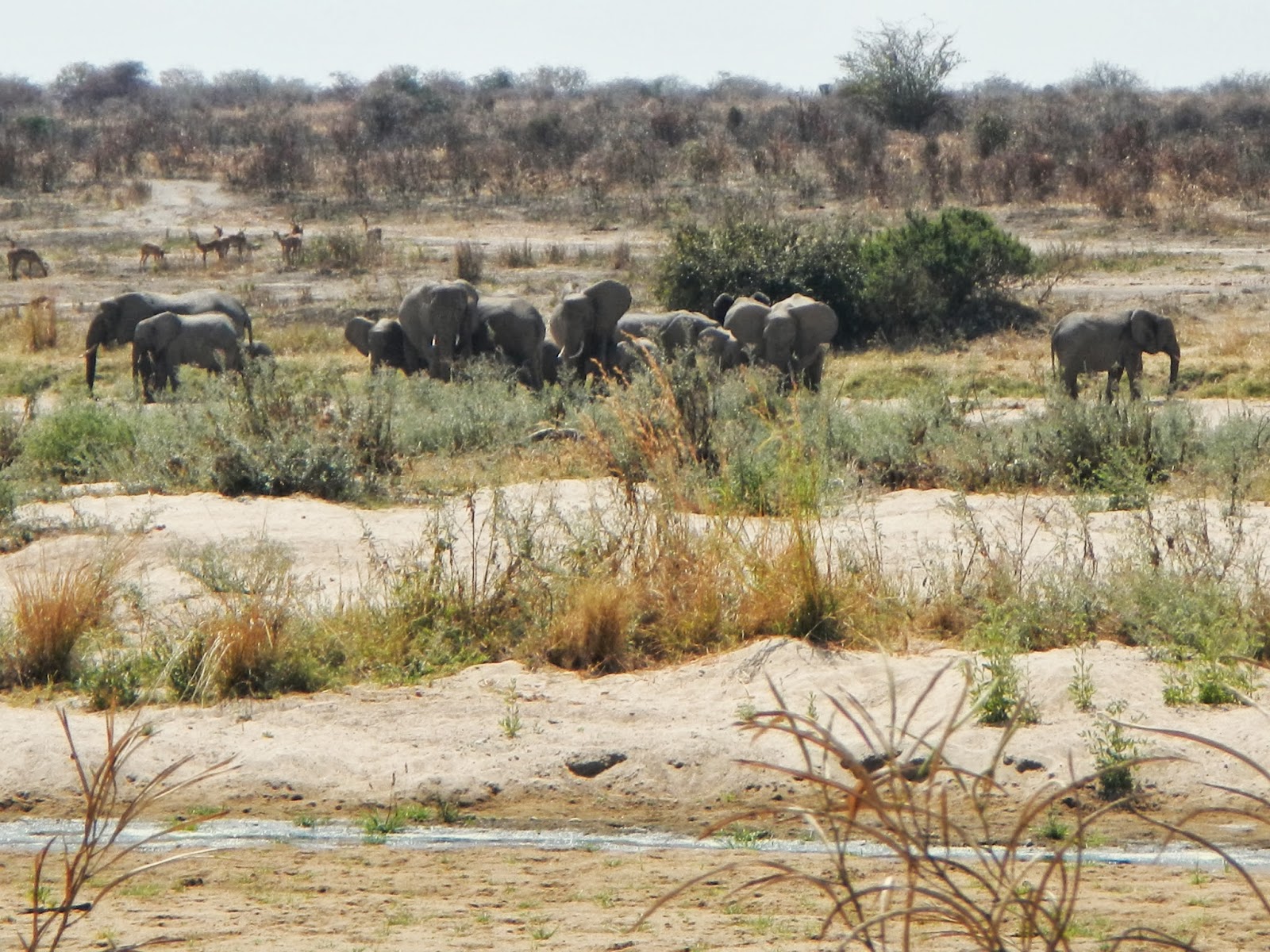
Waterbuk, baboon, blue monkey, dikdik, elephant HERDS, crocodile, impala, lions, hippo (with babies!), zebra, giraffe, vultures, storkbills, hornbills... like a Disney cartoon image, like a painted landscape, the great Sub Saharan East African plains in the dry season.

I'm in love withe baobab trees. Joseph picked up pods for us, broke them open, and gave us the seeds. You suck on them like candy; the hard coating tastes tangy and sweet - sort of like a lightly pickled plum or a SweetTart. Then you spit out the heart-shaped brown seed!


Thanks, John B, for the binoculars! Meggie checking out hippos, hanging in the slight current, some of the water that's not yet dried up.


Lions eating what we believe was a baby elephant. Later, we saw some eating a giraffe leg. Yes, it is scary to be in a totally open, rusted, rickety, seat-belt-free Jeep watching these guys. You could hear the bone crunch. You could hear them "purr".


Vultures waiting above the lions...


One of literally dozens of elephant herds:


I'm pretty excited about elephants, I won't lie.


Meggie couldn't pose; possibly the planet's loudest small bird screeched and she was making sure it wasn't coming for us.


The herds don't seem to mind the people in cars; interesting note - it is illegal to step beyond 5 feet of any road in the national park. Not exactly the backcountry hiking we do in our national parks! But while they don't mind us... they do NOT let the babies be seen very often...


This guy is not charging us! He is just looking at us, and then gave a huge head shake. It was a-dor-able.


It almost made me want to become a birdwatcher.


It makes perfect sense why giraffe are used to decorate baby nurseries. They're docile, they're fascinating to watch, they're non-threatening and their ears are really, really, cute. And they stare right back at you - just as weirded out by your body shape as you are by theirs.


This picture makes me laugh; using someone else's camera is hard, as my seat mate in the Jeep illustrates with her efforts here: 


This baby monkey chattered and yelled at us, and then when we pulled away, he ran out in front of the car, scooting like the dickens and howling for his life, for the next tree over - and his mama.


Yes, that is what it looks like. That's a dead, bloated hippo carcass in the river, with a bird on one side and a croc on the other - devouring it. It reeked of death, rot, and slime. I got video of it. It was awesome.


More elephants!


The lushness remains, even as the dry season creeps in from all sides.


We've been whipped around the van for about 7 hours at this point, hence looking so fresh-faced.


Crazy cactus.


I love this one. We crossed the Great Ruaha River many times - since the river is mostly dry right now. This is the riverbed of soft sand, and I liked thinking about the water flowing through, the great herds migrating. We're told that 85% of visitors come in the dry season to see animals. 15% come in the wet season to see plants, flowers and birds.


It really was a Disney cartoon at the end - we finally saw a much-desired warthog mom, running at sunset through the high grass with her tail up, so the three little babies behind her knew what to follow and where to go! 

Emmanuel speaks wonderful English - he tells me he learned from cartoons - and has a steady maturity that makes us all gasp when he says he is only 18. He is at university in Iringa but wants to go to South Africa and become a chef. I am uneasy about the situation - being guided through the park like royal visitors - but then again, if $530 is what most people make in a year, and our Jeep of 5 is going to tip him somewhere in the neighborhood of $80 or $100... are we helping him? Are we hurting others? Is he a good enough actor to pretend to enjoy his day with us - as he seems to? On the ride back, all questions about animals answered, we ask what he'd like to know about America. He wants to know about our big game - our bears, our mountain lions (they're not like your lions!), our moose. He wants to know about our roads (all tarmac, even in national parks?). He wants to know about rain and snow and our landscape. I ask about hospitals and medical care and he asks about health care in America - we get a little out of our depth with that one, but I try to explain that there is poverty in America, and what it looks like, how many people we consider "poor" and the ways we measure it. 

He stops on the road up to the lodge and picks hard berries from the ground - large, like a small kiwi. We're to rip them open and suck out the sweet pulp - amarula fruit. Emmanuel tells us that they fall to the ground, ripe and delicious, but after a couple days, they become dangerously alcoholic though the taste does not change! You have to know when they fell to eat them safely, and animals sometimes eat them too late too - the stories of drunken elephants rampaging through villages sound like lies, but at the lodge later, we learn they're true. An American group is there for a cold drink, though they're on a six month assignment with an NGO to build bee fences, which sound brilliant. 

Superficial as it may sound, back at the lodge and before dinner, I'm thinking about my tattoo #3. #1 was on my 18th birthday to celebrate adulthood and getting away to college. #2 to commemorate marriage. #3  - maybe a baobab tree to memorialize this trip? But the baobab can look angry, it can look joyful, it can look profound, it can look foreboding or funny or brokenhearted. What to pick? To emcompass it all?


The tree far away on this hill is a candidate for the tattoo design; it's two baobabs together, standing so proud and confident. 

Tuesday, September 10, 2013

July 25/26: Before the break, Part 2.

Before our two nights away, this is part two of my last evening of journaling in Pommern - after the first full week. I may be repeating myself a bit here, but it's as-written, knowing the next day I'd work a half day on the septic and then go... on a safari! 

After dinner.


My companion Paul writes about how he believes all of rural and poor Africa - as well as much of urban and poor Africa - is smellier and dirtier than it used to be. I can't make a comparison but I can it is so dirty, and so smelly. Is a small pan of water heated over the fire, and one small rag, too much? Maybe it is. But this is days, even weeks, of not washing. Some people not changing clothes at all, not since we've been here. I can't get over it; our pal Moses from the construction site can literally be smelled across the house. Meggie and I exchange glances when we smell him headed to the fireside for a warm-up.

The self-imposed no-alcohol while working/in the village/actively on the journey - i.e., not till tomorrow when we are on safari! - was hard tonight. Smelling it tonight, at a meal with meat - with beef! (Edward had to go to town today for veterinary supplies for Joe's volunteer work; he picked up a slab for us. Delicious.) It's the old Weight Watchers hold-out-aaaaalmost all week, but now it is Thrusday. And I'm tired of holding out!

But then, in the universe's lessons, always present, if you want to look - there were folks who drank too much tonight. And that's a screaming baby on a plane for birth control. It was what I needed to remember why I'm choosing to abstain. Why the luxury of a pre-packaged experience is to be put to good use, the best use, with total attention paid, with my own feet held to the fire.

No escape, no relaxation, no cheating to numb out even a bit. If I've had to learn this week to set boundaries (again!), and if I've had to let go of my illusions about African education, I at least owe ruthless honesty to the Pommerini by paying full attention.

Does me experiencing this make the world better? I try down to my teeth to not infantilize the non-worldy people, try not to condescend about the simple, happiness-loving folk who really know what's important in life. I try to meet square in the eye - and be always realistic - and always be ruthless. That's my motto. I know it's never been easy to be one of my friends, but I intent to be as hard on myself as I am on those I care about. But what is emotionally ruthless here? And is it in too much supply already?

What should I take away, when I go? At the near-halfway point, I'd tell you today I am fine with never coming back to Africa, and I'm constantly haunted by feeling like no mzungu should be here at all, least of all me. The best and brightest minds welcome us - but why? For more money? For prestige? Is it truly from a sense of service? Or a love of many worlds, and wanting the good from our world to come into theirs? Can it be enough to connect with a person, or two or three, and call it good at that? Is that what tentatively being a Unitarian Universalist is for me? Is that what I say it is?

Days ago I felt that I owed the women of Tanzania a big reach back at home, to balance our worlds. I was so happy to feel an achievable responsibility of creating connection far and wide, to weigh against the few connections they'll get to make just due to duties of food, water, and fire. But tonight my fears feel real and I'm no longer there. I am in that place I dreaded - where all I ever want is a small family of my own, to care for, and no more. No wider world. No big shadow, no community of hundreds. I want... ah shit. I realize - I want control. Total control. Because I guess this is groundlessness. And it's really scary.

Monday, September 9, 2013

July 25/26, Before the break, Part 1.

Before our two nights away, this is part one of my last evening of journaling in Pommern - after the first full week. I may be repeating myself a bit here, but it's as-written, knowing the next day I'd work a half day on the septic and then go... on a safari! 

I find that having secure shelter, safe food, clean water and English speaking friends means I can remain in a heightened state of observation more often than not. There's nothing rote here; there's no single unconscious action, from food to sleep.

Also: the showers that Joe and Marie and their family brought might be the greatest possession ever and I vaguely feel like I OUGHT to be ashamed of the daily 3 minutes of waist-height better-than-lukewarm water. But it's one thing I'm not embarrassed about. it's too powerfully restorative to feel guilty.

So during my peek into Lutheran choir practice today, and then hearing "Hey Ho" on Mamatony's battery-powered tinny kitchen radio - both bring me to tears. It's that heightened state, and I write this after working, after showering, feeling reborn. The tears come for scope of Africa's problems that I can't help - like how these women, their girls, and their girls' girls will live almost this exact life. I know I won't be able to fix anything of consequence for them, the ones right in front of me, even. Tears for the health, their hopes, for how they get smitten and fall in love but it probably does not make life much better. Again and again the beauty continues to pain me - more literally at times when I see this gorgeous place, with vibrant life humming in the very air, as also the source of their pain - geographically isolated from the power, but rich in natural resources ripe for the thieving.

And it becomes, over these days, apparent how we'll each divvy up the personal resources when they get scarce. Fellow volunteer Joe is wildly generous - having brought not just the sun showers for us all to use, but thousand (truly) of dollars in medical supplies. But when they are sorted and divided to take half to the clinic near us, and half to the Roman Catholic clinic across the village, he comes back harshly certain it was not only done wrong - ah, our attachment to literally giving the gift, to seeing the joy or appreciation or the reverence for the plenty we bring, the plenty we think we innately are - but that even more importantly, his personal medications were accidentally given away.

Now, look, I don't want to lose my Ciproflaxin either! But the pure possessiveness is both funny and part of the constant state of high alert I'm in, this constant open wound I am.

I see suddenly, my God, exactly what you would do with two servings of porridge and three kids.

And perhaps, at some point, what you would do with those two servings when one child becomes ill. And then gravely ill.

How Joe - and all of us - love our little things, things, things - and how our fresh-showered good humor and ability to poke fun at ourselves is there - until a very genuine threat arises. Someone gave away my pills, vitamins, medications. Then the entitlement to OUR items flares like Bilbo Baggins clutching after his ring, baring his fangs at a dear nephew.

And with that - Mamatony says dinner is served. I peel myself off the back deck and away from my rumination, away from my imagining of scarce, scarce food and what it would do - to me.

Tuesday, September 3, 2013

July 25: The Best Laid Plans

(As written in my journal that day; grammar and minor edits only. Italicized portions are additions written after the trip.)

Before Edward excused himself last night to go home, he warned Meggie and I that tomorrow, the headmaster would be gone from the secondary school.

"Things may not be as well there tomorrow. When he is gone, Madame Sbarra is in charge, and she can like to hide. She pretends not to see things, her head in the sand, like the ostrich bird. So just be aware of this. And when teatime comes, do not have tea with the teachers. Come back here to the mission house. It won't be good there, and you shouldn't be there at that time. Have some tea and toast here, and then you go back for your next assignments with Onalina in the secretary's office and Adrian for planning the physical exercise."

We walk down early, for a 7:30 AM class of different English students (one 50-minute period, not a double period this time!).

And? Mr. Msugu is out - but his substitute sure is ready for us to take over. And this is in fact the same class of students as yesterday (we were assured it would not be).

!!!

I freak out - inside. I get wide eyed and silent; the sub does not know what lesson we taught yesterday or where this English class is in their curriculum. I think he said he's been teaching for about five months?

But Meggie steps up. She sets the expectation - no, sorry, our plan is to observe and observe only, and here is what we taught in the Standard 3 book yesterday. He says, "Oh, ok, yeah, and then you'll teach the next lesson?" She is firm and says we'll be sitting by, but we can mark the papers - if the homework was indeed done.

It was extremely unclear at the end of yesterday's class whether any homework was assigned. The pat little lesson about Mr. Tortoise included a homework assignment. If you recall, the tale of Mr. Tortoise was a fable about how he ended up with a bumpy and cracked-looking shell. The homework assignment was to write a creative and original story that ends, "And that's why the snake has no ears." 

No small task in your first language, if you ask me - much less your third! However, homework was a vague concept to us - sometimes done at home, sometimes done in class, but always corrected/marked during class time. The sub wanted to know if homework was assigned and we shrugged. It was explained (sort of) while the bell was ringing yesterday; did the students take that to be an assignment due today, or a suggestion? I guess we'll find out - and the sub doesn't seem overly worried about it. 


Teachers are dressed down. The bell rings. Students are slipping in, late to class.

"Good morning teachers!" That rigamarole.

And of yesterday's two star pupils (the two that understood), just one, the boy, has done the homework. The rest of the class just blinks back at us. And his story is wonderful - the Frog convinced the Snake to trade over his ears so that all animals could see and hear equally well, but then took the ears and hopped away quick - not trading in his own eyes to the pile of senses. (Never mind that frogs don't have ears either; the basic concept of his story is there and has enough logic to stand.)

The sub asks who understood the story (it was read by the boy in English, of course). No hands go up. No nods. No eye contact.

The sub has been switching between Swahili and English and now says to the students, "I want to understand why the assignment was not done - what part did you misunderstand? Is it not understanding what creative writing IS or did you not understand what this one assignment was asking, about the snake and the ears?"

So at the sub's direction, our start pupil reads his story again in English, and then paraphrases it in Swahili. I'm soaring, watching eyes light up around the room with comprehension of this specific story and what the assignment was - and perhaps even the very basic concept of creative writing - making up a story from your own mind! - and I'm thinking, oh my gosh, we can explain the 5 W's now, using HIS story! This could be a tiny piece of helpfulness; heck, even writers and journalists in America can use a brush up on the 5 W's from time to time.

And literally as he finishes the Swahili recap, and heads for his seat in the back row among the tallest boys, two young women come in, with tall bamboo sticks. With a swagger. Swinging the sticks. I realize they're teachers, and though dressed very informally they're impressive and intimidating, and I say later to Meggie I thought right away, "They do a very good SS officer impression."

Then they ask all the boys in the back to stand up, shouting at them. Meggie and I are seated in the front and between us is a woman teacher who had a prep period, and rather than work in an office, asked to observe this class so she could, as she whispered to me at the start of the class, "get all the wisdom from you." She whispers to us what they yelling is about.

"The headmaster is gone, and they did not clean their rooms, you know, their dorm areas, this morning, so they have to be punished."

The women begin beating the kids with bamboo sticks. It's not fair to call them sticks; but neither are they quite bamboo poles. Somewhere in between.

They hit them - hard. Full, lean-back and put your back into it, get-a-good-grip and a fulcrum point hitting. Go-all-out beating. A beating that breaks the bamboo sticks eventually - in a few pieces, leaving shards behind and leaving students crying in their wake.

I look away pretty quickly and take in only the sounds - sticks hitting, kids screaming, other kids laughing, some gasping. The women teachers yelling. Ostensibly, it looks like corporal punishment is normally doled out on the palms - but those who don't volunteer their palms up at about head height are beat about the shoulders, back, head.

I look up as the women leave the room, sticks fairly demolished, and many of the children are pointing at each other and laughing, even with tear-stained faces of their own. A couple are quietly crying; many are blowing on their palms to take the sting out. I had to look down as the beating worked toward the crescendo - to not cry, and also because I didn't want to appear to condone it. I ask the teacher sitting with us, "Is this common, is this a regular thing?" and she says it is, but these women are wrong to do it without asking the presiding teacher's permission.

I think I can make it through the rest of class. I haven't looked at Meggie yet.

But then the sub asks us to go. "The students... the students they have a fever now. From this. They cannot learn well now. You go, and you come back another time." I'm a little confused and affirm with him - we should leave? Now? I point outside. Out the front door of the classroom? I point at our own chests. Us? Now? He nods.

We don't make it down the four stone steps before Meggie's losing it; it'll be a little later for me. Instead, you might have guessed, I'm angry at these women - these backwards, gleeful, power-hungry teachers. So ror a second day in a row, we walk up the long red-dust path from the secondary school to the mission house, my arm tightly around Meggie as she sobs and I clench my teeth in anger so hard it hurts.

Monday, September 2, 2013

What'd you wear?

People sometimes ask - what'd you guys wear?


This is pretty much what we looked like every day. Note my beloved Danner boots. And my clothing-swap and/or Ross-clearance fashion. (This is us on July 23, ah, the innocence! The smiles! I kid, I kid.)

Thursday, August 29, 2013

July 24, Pommern - Real Post.


(As written in my journal that day; grammar and minor edits only. Italicized portions are additions written after the trip.)

Picking up where I left off with yesterday...

Edward asked us for the day's rose and the day's thorn at dinner tonight.

Well, thorns first... so Meggie and I were assigned last night to our first real job: the secondary school. This morning, despite the pained glances last night and anxiety all through breakfast, we were delivered to Mr. Lemphoid Msugu (or at least that's what Edward thinks his name is; Edward is not great with names and I said to Meggie that if he struggles with pronouncing "Lemphoid" then I am perfectly fine calling him Mr. Msugu the whole time, which I can at least pronounce). 

He is an absolutely handsome young man in a sharply tailored narrow suit. The male teachers wear suits here - though they usually don't match coat to pants. And I saw more than one young man with the label still affixed to the outside cuff; I am guessing it looks cool, English writing, rather than incorrect, as it does to me.

With high cheek bones, almond eyes set wide, and a hefty dose of cologne (but hey, considering the alternative, it smells great), Mr. M is so eager to talk with us, to learn from us. We spend the prep hour or 75 minutes he has in the English Department office, talking. (The office is so small that we have to move the lone desk to sit in the two chairs. Then we pull the desk back over our laps, and Mr. M gets another chair to join us. There is now no room to walk in or out of the office, but perhaps the sign on the door is what keeps students away. "No English, No Service." The other English teacher is prepping - by reading a newspaper about futbol. He asks us if we know Thierry Henry and we try to describe America's MLS soccer and how there are few teams nationwide and we're watchers of the NFL (or I am at least), but on in our city, to have a popular team, is very rare... none of it lands. We clearly must live in a place where every city has professional futbol and everyone loves it; Americans are smart and it's a great game; you all love it, right?? Sure.) 

Mr. M asks me how people apply for jobs in America, and not being sure what he means, I stumble to explain that most jobs are posted on the internet, but that you would find one you liked and could do well, and then send in a resume and a cover letter. He doesn't know the word resume - but he does know curriculum vitae, of course, the British version! Then he shows me the lesson he designed on how to apply for a job, and it was excellent. Not only did it teach the proper steps of how to respond to a Help Wanted Ad and how to craft a CV, it was creative enough to teach persuasion (convince the business why you are a good fit), as well as some descriptive and instructional writing. He showed me his lesson on poetry, and a poem he wrote about love using a prompt in the syllabus (book) - and it's not Keats but it's not bad at all! Sprinkled through our time together, he says he is starting a unit on creative writing with his students today - who are about 9th/10th graders.

Since he first mentioned it, Meggie has been furiously writing ideas on how to talk about creative writing - what goes into it? How do you describe such a vast concept to students totally new to the idea? I'd rather ignore the ticking clock. But Meggie is making an outline. Character descriptions, motivations. The 5 Ws. Mr. M has never heard of the 5 Ws and really likes the idea. He asks if we will teach the lesson.

Pause.

Edward told all of us - except those on the water tower base construction project - that today was observation day. We'd be in classrooms (everyone else is at the primary school or the kindergarten; only Meggie and I are at the secondary school) to watch the teachers, and get a sense of the pace, the lessons, the students, the process.

But we stumble. We don't communicate with each other. I answer quickly and suggest we observe for ten minutes, and then take over. I believe the class is 50 minutes long. It's not until we're in the middle of one of those anxiety attacks where everything feels simultaneously sped-up and slowed-down that I realize it's a double period, and class is 100 minutes long.

We go as a group of three to the Academic Office to pick up the books. This is a pink book: English for Tanzanian Classrooms, Standard 3. Madam Sbarra, second in charge behind the headmaster, glares at us from behind her walled-in Academic Office, covered in dust and stacked with messy papers, and checks out the books for two days, begrudgingly. We get eight books - they are beat-up paperbacks in a totally British style, plodding from one little lesson - title, objective, reading, conversation questions, homework - to the next. English in a box, from literal language to concept.

We go to the Standard 3 classroom with the ringing of the bell.

"Good morning, teachers!" greets us all, in a shout.

Mr. M introduces us. There is a bit of giggling and lots of staring. There is a world map painted on the abck wall. Meggie speaks in her teacher voice. "Hello and thank you for having us. We are from America. Here is where we live in America..." and she walks back, through the deep rows, and puts her finger on a green bit of land on the far side of the United States. Boisterous and hysterical laughter erupts. I'm not sure still why this was funny. Was it because it is even farther than the side of America close to Africa?

Mr. M recaps the previous lesson to blank stares (it was about how to identify and complete those various types of writing - descriptive, instructional, persuasive, expository) and then turns to us, sitting on the side, in the front. "Now, you want to teach creative writing?"

"Oh God." Explosively, but under my breath. Just to Meggie. And away we go.

So many things we did wrong, and so much was laid bare. We were fooled yesterday by the uniforms, the polite and well-behaved room of about 56 students (my count was a little shaky; 53? 56?). All, all, ALL the talk of education so far as the only savior from the greater minds around us.

We begin our lesson by reading the story out loud as a group - thank god for Meggie the teacher knowing how to at least start off a lesson; I stand there frozen - and it's like me reading Spanish. I can do it, all day long, reasonably well. But do I know what I'm saying? No, and neither do they. The reading has hit or miss inflection and zero comprehension.

We get to the questions (the best part of class so far was the every-other-paragraph that I read, in an overly animated theatrical style, making them laugh at my expression even if they don't know the words) and it rapidly becomes clear that this is rote memorization at best, and bureaucratic plowing through a fucking British style textbook at worst.

In the next day or two I learn that they say, "Good morning, teachers!" And we say, "Good morning." They reply, "How are you?" and we respond, "Good, and how are you?" and they say, "Fine, thanks for asking!" But if I were to say, "Good morning," and then they asked how I was, and I said, "Why don't you go shit a brick?" they'd say, "Fine, thanks for asking!"

45 kids don't what is going on at all. 10 are muddling through, at 30-40 %. 2, one boy and one girl, get it nearly all of it. 2 of 56. Sharing seven books because sadly, Meggie and I take one to share so we have something to cling to, to teach from. "Teach" from.

The structure of class, the homework and the marking (Brit for grading) - it's all a goddamn sham. At least in America we don't lie to kids. We straight up tell them that money, fame and athleticism equals success and happiness. These lies... that this English class and this joke of an education system is the path to safety, security, income and success? Please. It's just another imperial/colonial trick. Well done, us. Too bad for you.

We're supposed to teach creative writing based on a fable about Mr. Tortoise - and how his selfishness and trickery landed him the bumpy, cracked-looking shell he has today - but they don't understand the fable's actual words, much less their metaphorical meaning or lessons about being kind to others. I don't think they know what a tortoise is. During the vocabulary section - structured AFTER trying to teach metaphorical language!!!! - Mr. M asks me what "great orator" means. Jesus. We need to go back to fundamentals. But these are 9th and 10th graders. That ship sailed. They learn in English all day - WHY!? Teach them about similes, characteristics, and proverbs in fucking Kiswahili! Get the concept in your second language before your third.

And this is one class in one school on one day in all of Africa.

A good school! (They tell us.) A respected school! (They tell us.) But when I give it up as my thorn, even Edward first asks if we marked papers today, or will need to tomorrow.  Bureaucratic habits. They can't go to their next class, see, until marking is done. So you're telling me (I say this in my head, not out loud) that they do the reading, learning, homework AND wait for grading of 56 assignments to take place during class? Well that's a great use of class time. Great use of limited teaching resources. Glad the teachers have hours of prep time each week to pull some non-sensical shit out of a book handed to them by the government and not expand on it at all - but they'll be godddamned if they don't get a 30 minute teatime break with hot mandazi, yes sir. I come to realize all the teaching and learning happens in the classroom and not a minute happens outside of it. Think how hard your teachers worked, and work, outside of the classroom!? My brain hurts. 

But it's not their fault either, and I know it - but to see the entire show, the entire joke of a system in concert with each ridiculous moving part at once, and how generations of this crap got us here... in a single moment... is... overwhelming. Dejecting. Anger and guilt inducing. And then the blame sets in, elsewhere, off the kids and off the teachers and off the system.

I never should have said OK to leading the class after ten minutes (that was actually two). How did I not see the true level they were at? Was the wool pulled over my eyes - as I feel - or is that a cover to protect myself? Why didn't I listen to my intuition when he asked for ten minutes of observation, then teaching? I cry a lot tonight; I hate the lesson of the great pain that comes from ignoring my intuition - but this lesson comes again and again and again, so I have much to learn.

And I ignored it because I can't say no here.

Sure, I can say no to giving away all my money. I can say no to food or water I know will make me sick. I can say no to things I'm too afraid to try - walking outside at night. But I can't say no to an emotional ask - there are no boundaries when it comes to a rural African teacher with just a year and four months' tenure asking me to pick up a book, in English, and teach it, in English.  I don't get to say no to that. That's an entitled person's boundary to set.

But then here I am, having not let myself set it, sobbing to Meggie, and in so doing failed myself and failed Mr. Msugu.

We let him show the kids that he thinks we're superior - and what? After two weeks, we go, and the next white American volunteer is also superior? We all are? There's my imperial system. It was our job to empower him by observing, encouraging, and maybe later suggesting. Our job to build him up and assist and serve him. I failed at it, because I couldn't listen to my inner voice and because I couldn't set a boundary, and that first world issue results in me causing hard to the third world. And with the tiniest bit of time I get to spend here, using it to hurt?... that feels significant enough to make me want to run away right now.