When you find yourself stuck with a dog-reactive dog, you cheer a text message exchange like the one we had this morning. John took Reno to the dog park, where we're working on his encounters with other dogs, which includes random use of the trusty ol' citronella collar.
John: He ran up to a dog bigger than him and sniffed its butt!!!
Me: YAY!!! That's amazing!!
Showing posts with label sigh. Show all posts
Showing posts with label sigh. Show all posts
Saturday, September 20, 2014

Monday, July 7, 2014
13 Weeks.
I keep saying that if I don't write it down, I'll forget, or be unable, to see if Reno is making any progress. So I'm writing it down.
We took him hiking three weeks ago. He has his own backpack because anybody, no matter their species, has their own backpack when they head out with John:


We brought him home 13 weeks ago yesterday. And so 13 weeks in, I am documenting that he has gotten more comfortable in our house. He can go up and down the stairs confidently, which was not the case originally. He still cannot go in the kitchen. He loves his kennel (aka his house) and sleeps easily in it every night for 8 to 10 hours.
He stays to his blanketed-spot on the couch nearly always, and has not jumped on the coffee table since that first day. He started wagging his tail, which when it began, was when we noticed that he had NOT been for a month! He now wags us a welcome in the morning, at night after work, and when we cross the room or have been gone for 3 minutes or more.
He jumps at fewer noises in the house, but still jumps at some.
And most importantly, let's chat about the reactivity. I'm not sure if he's less reactive - though I can say we are better at managing it. I can duck a dog heading our way before he even sees the thing. I can position us behind a parked car or in a stranger's driveway so that we can practice watching the dog walk by without his going over threshold. With me, he can currently handle a distance of across the street. Any closer, such as an unexpectedly chained or fenced dog, and he is over threshold in three seconds flat. It seems he can handle a closer dog with John.
One thing that has improved, without a doubt, is his recovery time. If he does go over threshold and starts lunging, growling, snapping and acting like he wants to devour the other dog, he can recover within one city block now.
Another improvement is that he has learned not only his name, but he's learned Sit and Shake! He is working on Down, Sit Pretty, and Come. I include Come in the 'working on' category because he's at about 80%. And 80% is really good but that other 20% is the time you really want him to obey. I don't know if any dog is 100% on the Come command. At the dog park, and on his long line, he has 90%+ recall of Come. We have not ever used it a true off-leash situation (because he's never been in one). So I call it 80%, to be safe.
But this past weekend was a slight digression from his improvement in anxiety reduction, thanks to the fireworks. Friday night the last ones that woke me up were at 2:05 AM. That erases any excuse that it's for the kids. I hate neighborhood fireworks. For Reno, the vet prescribed Xanax:

We took him hiking three weeks ago. He has his own backpack because anybody, no matter their species, has their own backpack when they head out with John:
He loved hiking. He did not love the other dogs, whether they were off leash or on.
He stays to his blanketed-spot on the couch nearly always, and has not jumped on the coffee table since that first day. He started wagging his tail, which when it began, was when we noticed that he had NOT been for a month! He now wags us a welcome in the morning, at night after work, and when we cross the room or have been gone for 3 minutes or more.
He jumps at fewer noises in the house, but still jumps at some.
And most importantly, let's chat about the reactivity. I'm not sure if he's less reactive - though I can say we are better at managing it. I can duck a dog heading our way before he even sees the thing. I can position us behind a parked car or in a stranger's driveway so that we can practice watching the dog walk by without his going over threshold. With me, he can currently handle a distance of across the street. Any closer, such as an unexpectedly chained or fenced dog, and he is over threshold in three seconds flat. It seems he can handle a closer dog with John.
One thing that has improved, without a doubt, is his recovery time. If he does go over threshold and starts lunging, growling, snapping and acting like he wants to devour the other dog, he can recover within one city block now.
Another improvement is that he has learned not only his name, but he's learned Sit and Shake! He is working on Down, Sit Pretty, and Come. I include Come in the 'working on' category because he's at about 80%. And 80% is really good but that other 20% is the time you really want him to obey. I don't know if any dog is 100% on the Come command. At the dog park, and on his long line, he has 90%+ recall of Come. We have not ever used it a true off-leash situation (because he's never been in one). So I call it 80%, to be safe.
But this past weekend was a slight digression from his improvement in anxiety reduction, thanks to the fireworks. Friday night the last ones that woke me up were at 2:05 AM. That erases any excuse that it's for the kids. I hate neighborhood fireworks. For Reno, the vet prescribed Xanax:
It worked for a while, and then it stopped. Next year, Xanax for me and a sedative for him. He is just today coming down fully off the heightened cortisol of the 3rd, 4th and 5th's all-day explosions. This dog has PTSD and I'm not even trying to be funny.
Of course what I'd like to see is for him to be able to pass an oncoming dog (first on the other side of the street, and eventually on the same side) without having a reaction. I'm not sure this will ever be possible; everything I read is not encouraging. But, at the 13-week mark, I can say he definitely is less anxious on walks - he does not cower at EVERY bicycle, loud car, shuffling foot, crunchy leaf. He only cowers at some of them. He used to pass all people with rolled-back ears and a low posture. He now is more perked up, almost looking like he could go over threshold, but he never does. He is less interested in people who are not me, John, and Auntie Beth (John's sister, and his bi-weekly dog walker).
He does not bark in the backyard ever anymore (thanks, we think, to the two weeks of the citronella collar), and now likes it out there - he goes out willingly and stays out there without us even, from time to time.
He is rarely interested in birds now; he saves that energy for squirrels - and cats, and dogs, of course.
He still sheds a ton; I think we're screwed on this one. When he's anxious, it seems to increase from the normal rate of Daily Shit Ton to a momentary Are You Dying? level.
In three more months, I'll remember to update on his reactivity, his leash-pulling tendencies (which are still fairly high, depending on the time of day) and his anxiety. Hopefully by documenting, there will be continued improvements seen, and thus we'll move away from feeling so on-the-fence about adding the little red leaner* to our house.
*Little Red Leaner is one of his nicknames; when he greets us in the morning, he likes to lean into us, or put the top of his head on your shin, or even on the floor, curling over and leaning in for maximum back scratchin.
Monday, June 16, 2014
Comin' up on the Jesus Year...
I've generally been the youngest in the group, whatever the group may have been… playground, locker room, homeroom class, new job or office, new tribe of friends. And as many of near-peers turn 33 in the year before I do, I get to look ahead this summer to my coming Jesus Year.
You're familiar, right? Even Urban Dictionary has an entry. And it's perfectly succinct: it's the year to get things done.
Over the last couple weeks, between a relaxing vacation, the new dog's ongoing antics, increasing work responsibilities, SIBO diet living, and the wonder of these long pre-summer days and evenings, my personal philosophy has (suddenly) expanded.
Please allow me one bit of back story first. Every family has it's lore and legends; in my family, there's a piece of lore that places me at about age 8 or 9, when my mother was having some normal-for-her, low-level, anxiety-filled, long verbal run-on about life, and challenges, and what does it all mean. When she turned the question to me, I said, "Don't ask me, Mom. I'm just a kid." Everyone laughed. And in a similar episode a few months later (as noted, this sort of out-loud rumination was the usual at home), I quipped back, "God, Mom. The point of life is that you make mistakes, and then you learn." (I do not remember the former exchange; I do remember the latter. We were at Murphy Lake and I wanted to touch the antlers of the stuffed elk in velvet on the wall but knew I was not allowed to.)
So this may have been my own self-stated guiding philosophy about life - from age 9, until very recently.
And suddenly… it feels sudden, having bubbled up in the past few weeks… I've decided that life is now about two other things entirely. It's about losing judgement, and it's about not being first.
I am a very judgmental person; I know how you should live your life, AND why. And I will happily tell you. Or if I don't know you, or you won't listen, I'll happily tell one of my friends. And now that I'm walking a little red dog around the block in a damn raincoat, a sweet little red dog that goes ballistic at the sight of another dog, I'm thinking, "Well, fuck." I didn't teach the dog to bark like that; he's not reactive because of me. But it sure as shit looks that way. And I don't love putting a raincoat on a dog, but he reacts to it a lot like he reacts to the Thundershirt and any way to take the edge off his anxiety is a good way to go. So I mosey along with our raincoats, and realize that I would normally look at me and judge the hell out of me. Uh-oh. Jesus Year. That means I have to start understanding people better. Give them more slack. Really, deeply believe they're doing the best they can with the tools they have - and not just say it.
And secondly (ha ha!), it's time to no longer be first. Who is not first in their own lives? Well - parents, for one. And spiritual leaders. And people dedicated to their jobs as deep vocations and true callings. In other words: the good eggs. The good eggs don't think about being first, and don't think about putting their own desires, satisfactions, whims, needs, moods, recognition and preferences first. The good eggs do make certain their own needs are met - sure, of course they do. But they do so mostly because it makes them better people who can turn around and better be able to serve and love the world. And you know what? For the first time in my selfish little life, that sounds really delightful. I get it. I paid lip service to not being first, but all along, I knew this was my movie, my soundtrack, and you were all supporting players. But this new philosophy - boy, does it take a huge load off. I don't have to be the center of my own universe. I can cook, read, play, love, work and write - like I do, and enjoy, of course - but it all doesn't have to be So God Damn Important. What a relief. To loosen my grip.
I mean - a bit. I'm not letting go, just letting up. I still think you're a huge fucking asshole if you take the outside seat on a bus. Just move goddamn over, dude.
You're familiar, right? Even Urban Dictionary has an entry. And it's perfectly succinct: it's the year to get things done.
Over the last couple weeks, between a relaxing vacation, the new dog's ongoing antics, increasing work responsibilities, SIBO diet living, and the wonder of these long pre-summer days and evenings, my personal philosophy has (suddenly) expanded.
Please allow me one bit of back story first. Every family has it's lore and legends; in my family, there's a piece of lore that places me at about age 8 or 9, when my mother was having some normal-for-her, low-level, anxiety-filled, long verbal run-on about life, and challenges, and what does it all mean. When she turned the question to me, I said, "Don't ask me, Mom. I'm just a kid." Everyone laughed. And in a similar episode a few months later (as noted, this sort of out-loud rumination was the usual at home), I quipped back, "God, Mom. The point of life is that you make mistakes, and then you learn." (I do not remember the former exchange; I do remember the latter. We were at Murphy Lake and I wanted to touch the antlers of the stuffed elk in velvet on the wall but knew I was not allowed to.)
So this may have been my own self-stated guiding philosophy about life - from age 9, until very recently.
And suddenly… it feels sudden, having bubbled up in the past few weeks… I've decided that life is now about two other things entirely. It's about losing judgement, and it's about not being first.
I am a very judgmental person; I know how you should live your life, AND why. And I will happily tell you. Or if I don't know you, or you won't listen, I'll happily tell one of my friends. And now that I'm walking a little red dog around the block in a damn raincoat, a sweet little red dog that goes ballistic at the sight of another dog, I'm thinking, "Well, fuck." I didn't teach the dog to bark like that; he's not reactive because of me. But it sure as shit looks that way. And I don't love putting a raincoat on a dog, but he reacts to it a lot like he reacts to the Thundershirt and any way to take the edge off his anxiety is a good way to go. So I mosey along with our raincoats, and realize that I would normally look at me and judge the hell out of me. Uh-oh. Jesus Year. That means I have to start understanding people better. Give them more slack. Really, deeply believe they're doing the best they can with the tools they have - and not just say it.
And secondly (ha ha!), it's time to no longer be first. Who is not first in their own lives? Well - parents, for one. And spiritual leaders. And people dedicated to their jobs as deep vocations and true callings. In other words: the good eggs. The good eggs don't think about being first, and don't think about putting their own desires, satisfactions, whims, needs, moods, recognition and preferences first. The good eggs do make certain their own needs are met - sure, of course they do. But they do so mostly because it makes them better people who can turn around and better be able to serve and love the world. And you know what? For the first time in my selfish little life, that sounds really delightful. I get it. I paid lip service to not being first, but all along, I knew this was my movie, my soundtrack, and you were all supporting players. But this new philosophy - boy, does it take a huge load off. I don't have to be the center of my own universe. I can cook, read, play, love, work and write - like I do, and enjoy, of course - but it all doesn't have to be So God Damn Important. What a relief. To loosen my grip.
I mean - a bit. I'm not letting go, just letting up. I still think you're a huge fucking asshole if you take the outside seat on a bus. Just move goddamn over, dude.
Monday, June 2, 2014
Products.
The list of products purchased for one little shelter dog, who no one would have missed from the world had we not gotten him (I refuse to say adopted; he is not a child):
- Walking harness
- Leash
- Front-clip walking harness
- Kong toy
- Second Kong toy
- Head halter
- Dog bed
- Kennel
- Doghouse
- Special couch blanket
- Interactive chewy ball
- Container to hold both kongs and chewy ball
- Two toys and one nylabone he will not use
- Citronella spray collar
- A series of 7 disgustingly ugly Ikea rugs for the main level of our home so that he can stop skittering across the hardwoods in terror
- Clicker
- a LOT of treats
- Thundershirt (monogrammed - thanks to John, not me; he loves personalization!)
Sigh.
Saturday, May 17, 2014
Negatory
SIBO test results: Negative!
NEGATIVE! SIBO GONE!
My methane was zero; my hydrogen was low enough to be normal, or at least non-SIBO. I feel like a Beagle Freedom Project dog - hesitant, tentative, eating things I want, but still sticking to what I know best most meals.
It's been a crazy almost-two-weeks since the news. Not so much because of the food, although that's interesting to explore, albeit obsessive in terms of tracking every bite at every time and connecting that to bowel movements to see what things agree, and which don't. But more than that, it's Life with Reno that's kept things a challenge.
My house is dirtier. My clothes sometimes have hair on them. My mornings start earlier and involve a walk. I check the clock at work and think about what he might be doing. His anxiety and leash aggression are not especially better, though I think we're more used to it. He's an inside dude - he is the gentlest, sweetest, most timid dog inside a house. Outside, we've discovered, his threshold for nervousness is literally a blowing leaf. One leaf? He's at a one. A blowing leaf and bicyclist? He's at a two. Add another dog? He's off the charts. So we've started having walks where we aim to keep things at no more than a one or two. This involves standing still on the sidewalk a lot, as he sniffs and stares, keeps his ears tippy-top tipped up, until he calms down a little and we can move on. It's very Zen.
When we get back, all that sniffing, stopping, seeing, staring, sighing, startling, skittishness and sensing… it results in a bunch of this:

NEGATIVE! SIBO GONE!
My methane was zero; my hydrogen was low enough to be normal, or at least non-SIBO. I feel like a Beagle Freedom Project dog - hesitant, tentative, eating things I want, but still sticking to what I know best most meals.
It's been a crazy almost-two-weeks since the news. Not so much because of the food, although that's interesting to explore, albeit obsessive in terms of tracking every bite at every time and connecting that to bowel movements to see what things agree, and which don't. But more than that, it's Life with Reno that's kept things a challenge.
My house is dirtier. My clothes sometimes have hair on them. My mornings start earlier and involve a walk. I check the clock at work and think about what he might be doing. His anxiety and leash aggression are not especially better, though I think we're more used to it. He's an inside dude - he is the gentlest, sweetest, most timid dog inside a house. Outside, we've discovered, his threshold for nervousness is literally a blowing leaf. One leaf? He's at a one. A blowing leaf and bicyclist? He's at a two. Add another dog? He's off the charts. So we've started having walks where we aim to keep things at no more than a one or two. This involves standing still on the sidewalk a lot, as he sniffs and stares, keeps his ears tippy-top tipped up, until he calms down a little and we can move on. It's very Zen.
When we get back, all that sniffing, stopping, seeing, staring, sighing, startling, skittishness and sensing… it results in a bunch of this:
Monday, May 5, 2014
Teeter Totter
I have been so sure the SIBO is going to be gone. And then I get struck with fear, and am so sure it is not gone. I can't do this diet for much longer; well, in fact, I'm not doing it now. I have been sneaking little cheats more days than not. So my punishment will surely be SIBO forever, right? So it goes - back and forth, back and forth - or as my brother said when he was a toddler, "Back and thorf, back and thorf."
The results are not in yet, and today is a day where I am certain it is gone. I have noticed that I "recover" digestively from the cheat foods faster and faster; it must be gone, then, right? But I still need a little time to recover, so it must not be gone then, right? Gah!
And in the middle of it all, we're getting used to Reno. And he's getting used to us. He looms large in my daily existence; I think about him (ahem, I worry about him) when I'm away from the house. Is he bored? Is he getting into trouble? Is he eating the rawhide bone and not just chewing it properly? If he's in the house, does he have to pee or poop? If he's outside, is he scratching at the fence or digging? All the anxiety, at this point, is outweighing the fun parts. Yes, he's cute. And yes, it's lovely to sit right now with him curled up on his blanket at the end of the couch (we're doing pretty well with keeping him to his 'place' there). He is funny when he's in sniff-mode on our morning walks. But he also could give two shits about loose-leash walking most of the time, and pulls all of his 19 pounds against the leash, and then barely acknowledges my existence when John is around, he is mostly too timid to go up the stairs, and he sheds like a bastard. Life was a lot easier before he was around. I can't remember why I wanted to get him so bad in the first place.
He also hates the rain, which is really funny. He stops every third of a block to shake - which makes walking a long process - and sometimes will not come out from under a tree when it's raining hard. He stood under my legs the other day and looked me so plaintively; what the heck is this wet crap?! So the natural next step is... to buy him a raincoat! Tah dah:


The results are not in yet, and today is a day where I am certain it is gone. I have noticed that I "recover" digestively from the cheat foods faster and faster; it must be gone, then, right? But I still need a little time to recover, so it must not be gone then, right? Gah!
And in the middle of it all, we're getting used to Reno. And he's getting used to us. He looms large in my daily existence; I think about him (ahem, I worry about him) when I'm away from the house. Is he bored? Is he getting into trouble? Is he eating the rawhide bone and not just chewing it properly? If he's in the house, does he have to pee or poop? If he's outside, is he scratching at the fence or digging? All the anxiety, at this point, is outweighing the fun parts. Yes, he's cute. And yes, it's lovely to sit right now with him curled up on his blanket at the end of the couch (we're doing pretty well with keeping him to his 'place' there). He is funny when he's in sniff-mode on our morning walks. But he also could give two shits about loose-leash walking most of the time, and pulls all of his 19 pounds against the leash, and then barely acknowledges my existence when John is around, he is mostly too timid to go up the stairs, and he sheds like a bastard. Life was a lot easier before he was around. I can't remember why I wanted to get him so bad in the first place.
He also hates the rain, which is really funny. He stops every third of a block to shake - which makes walking a long process - and sometimes will not come out from under a tree when it's raining hard. He stood under my legs the other day and looked me so plaintively; what the heck is this wet crap?! So the natural next step is... to buy him a raincoat! Tah dah:
But even I question - does a doggie raincoat really need a hoodie on it?
And no - we have not used it yet.
Thursday, March 6, 2014
Cheater.
So today, I cheated.
Tomorrow marks eight weeks - two fucking months - of living grain- and refined-sugar- free.
And I have not cheated, not once. And if you don't know, I work in a literal candy store. Yes, it's a software firm, but it's all the tales you've heard about these insane, hedonistic, childlike Googlesque workplaces? They're true.
Snack plates are put out once or twice a day in the three most high-trafficked areas. Perhaps brie and summer sausage, perhaps guacamole and chips, perhaps almond mini croissants and a bowl of coconut whipped cream, perhaps peanut butter-filled celery sticks. And that's just those three areas. Then each kitchen (there are also three) is stocked: a cereal cabinet with 15+ kinds. A candy cabinet, a cracker drawer, all the bagels, bread, and muffins you could want (cinnamon raisin, plain, vegan, wheat, etc.). There is a sweets cabinet - Oreos, Petit Ecoliers, Nutter Butters. There are at least ten kinds of granola bars: Kind, Kashi, Nature Valley, PowerBar, Clif. There is, ok, a nod to health, with a fruit bowl. But there is a soda cooler, there is beer and wine, there is endless tea and coffee with your choice of soy, coconut, almond, regular, skim, whole and lactose free milk - half and half. (One guy eats two bowls of cereal a day, with half and half as the backdrop.)
This is meant for us to enjoy, every day, all day, for free, day in and day out. Since the second I have worked there. There is also at least one company lunch each week from the nearby food carts (variety makes it impossible to prepare your defenses against the deliciousness), and I've yet to work a week there when there is not also another pile of leftovers for lunch or at about 3 PM, everyone's best time to avoid high-cal snacks - it is often Voodoo Doughnuts, or Elephants Deli sandwiches, or Pizzicato pizza of six or seven varieties.
Oh, and we have a monthly food holiday - National Milkshake Day was one. Just come order up! The soda jerk is ready to help you out.
And so it is that in the face of this, I have not cheated once. Not one time. I have not eaten half a broken Chips Ahoy as I filled the cookie jar. I have not licked the spoon after slicing up chicken enchiladas. I have not had a Twizzler. Not a Dove chocolate square. Not the edge of a pizza slice. Not a quarter of a doughnut. And yet it's all staring me in the face, for the eight to ten hours a day, sometimes more, that I spend in the office.
But today, friends, I broke.
I came to work to help set up a breakfast buffet for visiting colleagues from the remote offices. French Toast. And pancakes. And look; I love pancakes like Phillip Seymour Hoffman loved speed balls. One is never, ever, ever enough. There were mountains of butter pats and maple syrup. But no, I set it up - and I walked away.
Then I attended a lunch event on behalf of the company. We were served a chicken sandwich on fluffy ciabatta. And if I can't get heroin but I can get oxycontin, to continue the inappropriate and gross metaphor, then bread is the very best next thing after a pancake.
But I didn't eat it. I ate the chicken out of the sandwich. I declined the basket of rolls (yes, rolls, with a sandwich, good sweet Jesus) and I declined the cookie assortment after that. It's true that I love cake more than cookies, but don't get me wrong - I love a cookie, even a bad one, too.
I made it back the office, still slightly hungry. I decided to heat up my almost-cooked-into-baby-food-texture carrots and a little beef short rib. And what is waiting in the kitchen?
A Thai buffet. With a giant hotel pan of fluffy, steamed white rice.
My doctor told me that if I'm melting down, and freaking out, the very best cheat on this diet is white rice. It has no nutrition - it has no fiber to feed the SIBO bacteria - and it goes right through you.
And willpower, as scientists are learning, is a muscle. Like any muscle, it can get fatigued. It needs rest to get strong again. I think - side note - this is why I am averaging 8.5 hours a night of sleep right now. I need to replenish the willpower reserves! And by the way, people with kids, plug your ears: that is 8.5 hours of sleep. I measure it with my UP band. I'm actually IN bed a good 9 hours or more. That's the pure, sweet sleep of someone not actively consuming peanut butter by the gallon, hoping to stop thinking about bread and pancakes.
So the willpower muscle was tapped out, and I added about a third of a cup of fluffy white rice to my dish. And Oh. My. Lordy. It tasted like sugar. No. It tasted like nectar. It was like some kind of divine manna. And I am talking white rice, I know. But it was almost funny, I almost laughed - how good it tasted.
And then, about twenty minutes later, I felt like I was on speed myself. I was hyper alert. Vigilantly awake. I was giddy, smiling. I had more energy than I have had in weeks. I was giggly, bright, amazed. What a world! What a day! What a gorgeous life! I'm going to the gym, to my crazy-tough fusion workout class!
Which I promptly did. And I set a new (self) pushup record, which my teacher noticed and was impressed by.
Powered by the blandest thing in the world. I may be a cheater, but I'm definitely a rice rocket today.
Tomorrow marks eight weeks - two fucking months - of living grain- and refined-sugar- free.
And I have not cheated, not once. And if you don't know, I work in a literal candy store. Yes, it's a software firm, but it's all the tales you've heard about these insane, hedonistic, childlike Googlesque workplaces? They're true.
Snack plates are put out once or twice a day in the three most high-trafficked areas. Perhaps brie and summer sausage, perhaps guacamole and chips, perhaps almond mini croissants and a bowl of coconut whipped cream, perhaps peanut butter-filled celery sticks. And that's just those three areas. Then each kitchen (there are also three) is stocked: a cereal cabinet with 15+ kinds. A candy cabinet, a cracker drawer, all the bagels, bread, and muffins you could want (cinnamon raisin, plain, vegan, wheat, etc.). There is a sweets cabinet - Oreos, Petit Ecoliers, Nutter Butters. There are at least ten kinds of granola bars: Kind, Kashi, Nature Valley, PowerBar, Clif. There is, ok, a nod to health, with a fruit bowl. But there is a soda cooler, there is beer and wine, there is endless tea and coffee with your choice of soy, coconut, almond, regular, skim, whole and lactose free milk - half and half. (One guy eats two bowls of cereal a day, with half and half as the backdrop.)
This is meant for us to enjoy, every day, all day, for free, day in and day out. Since the second I have worked there. There is also at least one company lunch each week from the nearby food carts (variety makes it impossible to prepare your defenses against the deliciousness), and I've yet to work a week there when there is not also another pile of leftovers for lunch or at about 3 PM, everyone's best time to avoid high-cal snacks - it is often Voodoo Doughnuts, or Elephants Deli sandwiches, or Pizzicato pizza of six or seven varieties.
Oh, and we have a monthly food holiday - National Milkshake Day was one. Just come order up! The soda jerk is ready to help you out.
And so it is that in the face of this, I have not cheated once. Not one time. I have not eaten half a broken Chips Ahoy as I filled the cookie jar. I have not licked the spoon after slicing up chicken enchiladas. I have not had a Twizzler. Not a Dove chocolate square. Not the edge of a pizza slice. Not a quarter of a doughnut. And yet it's all staring me in the face, for the eight to ten hours a day, sometimes more, that I spend in the office.
But today, friends, I broke.
I came to work to help set up a breakfast buffet for visiting colleagues from the remote offices. French Toast. And pancakes. And look; I love pancakes like Phillip Seymour Hoffman loved speed balls. One is never, ever, ever enough. There were mountains of butter pats and maple syrup. But no, I set it up - and I walked away.
Then I attended a lunch event on behalf of the company. We were served a chicken sandwich on fluffy ciabatta. And if I can't get heroin but I can get oxycontin, to continue the inappropriate and gross metaphor, then bread is the very best next thing after a pancake.
But I didn't eat it. I ate the chicken out of the sandwich. I declined the basket of rolls (yes, rolls, with a sandwich, good sweet Jesus) and I declined the cookie assortment after that. It's true that I love cake more than cookies, but don't get me wrong - I love a cookie, even a bad one, too.
I made it back the office, still slightly hungry. I decided to heat up my almost-cooked-into-baby-food-texture carrots and a little beef short rib. And what is waiting in the kitchen?
A Thai buffet. With a giant hotel pan of fluffy, steamed white rice.
My doctor told me that if I'm melting down, and freaking out, the very best cheat on this diet is white rice. It has no nutrition - it has no fiber to feed the SIBO bacteria - and it goes right through you.
And willpower, as scientists are learning, is a muscle. Like any muscle, it can get fatigued. It needs rest to get strong again. I think - side note - this is why I am averaging 8.5 hours a night of sleep right now. I need to replenish the willpower reserves! And by the way, people with kids, plug your ears: that is 8.5 hours of sleep. I measure it with my UP band. I'm actually IN bed a good 9 hours or more. That's the pure, sweet sleep of someone not actively consuming peanut butter by the gallon, hoping to stop thinking about bread and pancakes.
So the willpower muscle was tapped out, and I added about a third of a cup of fluffy white rice to my dish. And Oh. My. Lordy. It tasted like sugar. No. It tasted like nectar. It was like some kind of divine manna. And I am talking white rice, I know. But it was almost funny, I almost laughed - how good it tasted.
And then, about twenty minutes later, I felt like I was on speed myself. I was hyper alert. Vigilantly awake. I was giddy, smiling. I had more energy than I have had in weeks. I was giggly, bright, amazed. What a world! What a day! What a gorgeous life! I'm going to the gym, to my crazy-tough fusion workout class!
Which I promptly did. And I set a new (self) pushup record, which my teacher noticed and was impressed by.
Powered by the blandest thing in the world. I may be a cheater, but I'm definitely a rice rocket today.
Monday, March 3, 2014
A Whole Lotta Nothin' Goin' On
I'm stuck in neutral over here - in the next couple days, I'll get the SIBO Test #2 results. As I've said, I'm certain it's not gone - but I'm dying to know what the reduction is. In half? Less? More? How much bacteria do we think is still in there, wreaking havoc?
But in the meantime, there's a whole lotta nothing going in, dietarily. I've admitted that almond flour and me don't get along. Things seem to be better with coconut flour, but I have more experimenting to do this week. It really is like the universe is trying to take away ALL my food joys. At least I still have peanut butter, and I'll be giving that up with cold, dead fingers, trust me.
I haven't added in many new foods; I'm still figuring out what amounts of the existing list of 25 or so are good, and which cause belly aches or bad poops. And it's getting depressing. I don't get to participate. At work, I ordered ice cream sandwiches - even gluten free ones, and vegan ones. But no makes a grain free, refined sugar free ice cream sandwich. I order lunch for the whole company every Friday, but I never get to eat it. I put out the snack jars a couple times a week, but there are no snacks for me. It's boring. It's isolating. It's frustrating and at some point, if I don't start getting healthier, the depression is going to outweigh the striving for health, and I'll go back to the SAD. (Standard American Diet.)
But know this, friends. Maranatha nut butters? They all contain cane sugar of some sort! Those little liars. Give me Justin's every day of the week.
But in the meantime, there's a whole lotta nothing going in, dietarily. I've admitted that almond flour and me don't get along. Things seem to be better with coconut flour, but I have more experimenting to do this week. It really is like the universe is trying to take away ALL my food joys. At least I still have peanut butter, and I'll be giving that up with cold, dead fingers, trust me.
I haven't added in many new foods; I'm still figuring out what amounts of the existing list of 25 or so are good, and which cause belly aches or bad poops. And it's getting depressing. I don't get to participate. At work, I ordered ice cream sandwiches - even gluten free ones, and vegan ones. But no makes a grain free, refined sugar free ice cream sandwich. I order lunch for the whole company every Friday, but I never get to eat it. I put out the snack jars a couple times a week, but there are no snacks for me. It's boring. It's isolating. It's frustrating and at some point, if I don't start getting healthier, the depression is going to outweigh the striving for health, and I'll go back to the SAD. (Standard American Diet.)
But know this, friends. Maranatha nut butters? They all contain cane sugar of some sort! Those little liars. Give me Justin's every day of the week.
Thursday, October 10, 2013
Tanzania: Epilogue
The last night's dinner was lovely - three of us were leaving, and eleven were staying another week. The three of going said a few words to each other volunteer, and then the eleven said something to us three.
Turns out, I was appreciated mainly for being sarcastic, and funny, and calling shit "shit" when it was needed. I was also given what I think of as a blessing... told that Meggie and I are seekers, and for seekers, the journey and the experience are often the whole purpose, not the destination. I was admired for being in a marriage that "allowed" me to travel alone, to complete my heart's calling, that it was ok it was not John's heart's calling. Meggie and I were solemnly toasted as a model of a beautiful friendship, a model others said they're going to strive to emulate.
We were up in the dark Friday morning - but Mamatony was too, with a little green onion omelette and toast for our journey. This time, we drove all the way to Dar in one push - stopping only for lunch, and for more "surprise!" experiences with public toilets. (You never know what you're going to get, but I learned one thing - check the faucet first, see if there's running water. It's just good to know before you see what the stall has to offer.)
We got to Dar in the dark, and went to one of those food-court strip-mall places that you see and read about it in the developing world. Attached or near a shopping mall, they're bad food in a safe setting, they're places the middle class socializes with itself, and shows off as members of the middle class. Meggie and I had burgers - she had beef, but I wasn't quite ready to let go of the flavors of coastal Tanzania, and had a chicken tikka masala burger. I tried to get a photo of the sign across the street - we make fun in America of "any excuse for a sale" but this was pretty well on par:
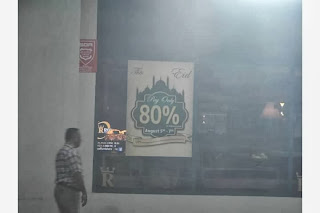
(That's "Pay only 80% during Eid!" I think 20% off is smarter than pay 80%, but there must be a learning curve up to American standards of marketing.)
We stayed at the same hotel from two weeks earlier; this time, we comfortably strolled around the market area, got an ice cream, had a glass of wine at the oceanfront restaurant and felt perfectly at ease with the currency, the people, the music. This time we knew to expect a Ramadan party all night, and put in ear plugs. And oh - the shower. The long, hot shower. To be honest, I showered first, and Meggie said, "How'd it feel!?" And I said, "Just OK. That shower was getting the grime off. Tomorrow's shower will be one I can enjoy."
(Me after 6 days without even attempting a hair wash, and just a couple half-bag half-warm sun showers from the safari in Ruaha, up through the last week. My hair was so fantastically matted, I could shape it into any style.)

The next day was Saturday, and all flights leave Dar for Europe at night - so we spent the day shopping, buying trinkets and thank you gifts for our supporters, trying some candy and Saudi Arabian dates. We learned a new tradition from a volunteer... when people leave, don't wave. Don't say goodbye. Dance them off, and then you can dance them home again when they return. So we danced off the first of us to leave (she sent this ridiculous picture later, and note I am still snug as a bug in a rug in my hiking boots:)

And then we went for an early dinner. Note the Sprite - I'm considering it medicine still, at this point.


Turns out, I was appreciated mainly for being sarcastic, and funny, and calling shit "shit" when it was needed. I was also given what I think of as a blessing... told that Meggie and I are seekers, and for seekers, the journey and the experience are often the whole purpose, not the destination. I was admired for being in a marriage that "allowed" me to travel alone, to complete my heart's calling, that it was ok it was not John's heart's calling. Meggie and I were solemnly toasted as a model of a beautiful friendship, a model others said they're going to strive to emulate.
We were up in the dark Friday morning - but Mamatony was too, with a little green onion omelette and toast for our journey. This time, we drove all the way to Dar in one push - stopping only for lunch, and for more "surprise!" experiences with public toilets. (You never know what you're going to get, but I learned one thing - check the faucet first, see if there's running water. It's just good to know before you see what the stall has to offer.)
We got to Dar in the dark, and went to one of those food-court strip-mall places that you see and read about it in the developing world. Attached or near a shopping mall, they're bad food in a safe setting, they're places the middle class socializes with itself, and shows off as members of the middle class. Meggie and I had burgers - she had beef, but I wasn't quite ready to let go of the flavors of coastal Tanzania, and had a chicken tikka masala burger. I tried to get a photo of the sign across the street - we make fun in America of "any excuse for a sale" but this was pretty well on par:

(That's "Pay only 80% during Eid!" I think 20% off is smarter than pay 80%, but there must be a learning curve up to American standards of marketing.)
We stayed at the same hotel from two weeks earlier; this time, we comfortably strolled around the market area, got an ice cream, had a glass of wine at the oceanfront restaurant and felt perfectly at ease with the currency, the people, the music. This time we knew to expect a Ramadan party all night, and put in ear plugs. And oh - the shower. The long, hot shower. To be honest, I showered first, and Meggie said, "How'd it feel!?" And I said, "Just OK. That shower was getting the grime off. Tomorrow's shower will be one I can enjoy."
(Me after 6 days without even attempting a hair wash, and just a couple half-bag half-warm sun showers from the safari in Ruaha, up through the last week. My hair was so fantastically matted, I could shape it into any style.)

The next day was Saturday, and all flights leave Dar for Europe at night - so we spent the day shopping, buying trinkets and thank you gifts for our supporters, trying some candy and Saudi Arabian dates. We learned a new tradition from a volunteer... when people leave, don't wave. Don't say goodbye. Dance them off, and then you can dance them home again when they return. So we danced off the first of us to leave (she sent this ridiculous picture later, and note I am still snug as a bug in a rug in my hiking boots:)

And then we went for an early dinner. Note the Sprite - I'm considering it medicine still, at this point.

And after a long, dusty trip to the airport, after buying Cuban cigars for John at the duty-free, we got to our waiting area at the airport - where the plane was late, there were no updates announced, and only Meggie's French managed to get us an explanation from the Swiss Air steward! We took off about an hour late, first for Nairobi and then for Zurich. One last photo at the airport....

And then we slept - sort of - but flew in relative silence. The guy in front of us puked the whole flight. The woman in the aisle over had malaria and was cutting her trip short.
Arriving in Zurich, our lateness meant Meggie had to run to catch her plane to Paris. I was to have my two nights in Zurich... and realized I had no idea how to get to my hotel, where it was in the city's districts (beyond an address), or how to use public transit. We squeezed hands and I shrugged and laughed, "I 'm sure I can figure it out!" Calmest I've ever been. I mean, there were clean toilets and drinking fountains I could use. How bad could it be? Meggie provided me with a few French phrases to use, and I wandered through customs (they thought it was very odd that I was staying in Zurich under 48 hours) and then up to an information booth. I got some Swiss Francs, I brushed my teeth, and I left the airport, determined not to take a taxi but to figure out the buses and trains, to get to Hotel St. Georges on my own, and ate my very last nutrition bar.
It took three hours to do it - and should have taken about 40 minutes - but I got there. Zurich on a Sunday morning, with the church bells vibrating my skull, and hardly a person out, with all the shops closed, was as other-wordly as a Tanzanian dirt path. My room was miraculously ready for an early check-in. I opened my third floor window. I looked out on this:

I took a long, long shower and put on a podcast of The Splendid Table. Then I headed out to see Lake Zurich with the Sunday revelers.
It's all in the journey.

Wednesday, October 9, 2013
Last Night in Pommern, August 1.
(As written in my journal that day; grammar and minor edits only. Italicized portions are additions written after the trip.)
I'm sitting watching the sun set, and thinking how I wanted to feel the air and see the light in Africa - would it be so different?
Yes and no. It reminds me of remote Montana or Canada in clarity and vividness - and yet there is something different. There's a heightened sense of isolation, of danger. Like, something bad happens out here and sister, you're on your own. That gives it excitement - but a wary edginess I can't shake, no matter what time of day, no matter whether I'm outside or in the mission house.
Maybe Maslow's layer of security makes us soft Americans, but displaying a tender heart is what Pema counsels us to have. Is poverty different in a Buddhist society? Although, things that are part of society here are not stolen - our iPods would be, but that neither the pile outside the clinic nor the bikes, bricks or lumber we see outside the Lutheran church for days are. So perhaps this is as peaceful a place - minus teachers with sticks, of course!! - as it can get. Or is it a detente of sorts? A recognition that you don't take bread out of a hungry man's mouth, even you're starving too - even if you're starving more.
I've also been thinking today, after the clinic experience, about my possessions - things here, like the little nail clippers I brought and just used, that work so perfectly for their one exact use - and things awaiting me at home, like the exact right clothing for a mood, for the weather, for a celebration or mourning at hand. And people told me, and I expected, to think of my possessions with awe at how much, too much, I have. But you know what? I don't think that.
I think... I'm so grateful to have what I do, and I have long been trying to value it all by only keeping things I love. I already work to implement rules. No continuing to wear something I don't feel great in. No more decor pieces I used to like, or was given as a gift and I feel too guilty to give to Salvation Army. No extras - we currently have only one set of sheets, a half dozen towels, no good china (just one set of dishes I like and use daily), no more clothes than can all fit into my closet at any one, single time (a full ban on seasonal wear that cycles in and out of storage!).
So I look around here at people who own so little and I don't feel guilty for what I have because I'm not unconscious about it. It's not wrong to possess an item because it brings joy or beauty or function or ease to my life. It is wrong, maybe, to possess an item I don't use, like, or enjoy.
So it hits me. I expected to discover totally new things on this trip - new realizations, thoughts, conclusions about human nature and history and spiritual life, revelations about the rest of my own life! But - that has - I think - universally not occurred.
Instead, all the revelations - the aha moments - and experiences and ideas here are connected to current ones. I see the through-lines of my own growth and spiritual maturation. What brought me here continues to be experienced here, and will continue when I get home. Everywhere I go, there I am. There's nothing new under the sun, or even inside me. All of the learning, here, is part of what I already wanted out of life, what I already seek - giving up control in order to be freer, calmer, more loving and compassionate and kind. Giving up rigidity in order to experience joy and surprise, to be present in the moment with gratitude. And, I sigh as I write this. It's so fucking hard.
I stop short here of saying "be happier" though because I don't pursue happiness, as a general rule. I don't use happiness as a yardstick to measure much of anything. I use novelty, excitement, especially accomplishment and completion, to judge success. When those line up, happiness probably follows. But I'm a terrible judge of putting happiness first - usually, I end up overeating, over drinking, oversleeping or oversharing, and the thing that was supposed to make me happy makes me bloated, tired, embarrassed or hung over.
Far better to use the other yardsticks, and far better to keep a continued, and ever-honed, sharp eye on my possessions as a tool to ensure this feeling of value, appreciation... real gratitude even in material things... is not at all out of place.
Tuesday, October 8, 2013
August 1: Last full day in Pommern.
(As written in my journal that day; grammar and minor edits only. Italicized portions are additions written after the trip.)
It's CTC day - and through Meggie's excellent manipulative conversation skill with Edward, she's gotten me out and about, assigned alone to the Clinic, and herself over to the primary school - where she has wanted to volunteer since we arrived.
CTC means Counseling and Test Centres - the HIV/AIDS clinic that serves seven villages, including Pommern. My energy is too low to do justice in describing the inefficiency with which 62 AIDS patients were seen today, at this monthly clinic. It is actually every Thursday, but each patient is on a monthly rotation - first Thursday, second Thursday, etc. They get ARVs or other drugs. And it wasn't the plain, pitiable, understandable inefficiency of no shelves, drawers, computerized lists of patients, or drug inventory. It went far beyond that and I want to do it justice when I have the patience to walk through it in each excruciating detail.
After a long morning of work, and a late lunch, Meggie and I said our goodbyes to the tech and athletics team at the secondary school, who made Zumba possible, Adrian and Flavian. And then to Nurse Patricia. Meggie's totally hellish morning in the primary school has moved her to an interesting place - from guilt or pity to frustration that people are not helping themselves. I remember my brother being there, then in another phase of compassion, and finally he moved into a sort of Zen acceptance. Acceptance by attrition, maybe!
To try to do this description justice... first you have to imagine a cold morning, and the cement clinic. People "line up" to be "checked in". I use quotes because they sort of stand or sit around, near the door to the children's ward - no kids here today, so apparently it will be the CTC clinic. Every person has already waited outside on the far side of the clinic - the shaded, coldest area - to be tested (I can't see this happening; is it a blood test? A weight on the scale? Something else?) and given a number on a scrap of paper. Then they mill over to the yard in the sunshine, in front of the children's ward, where I sit at a table with another huge bound book in front of me.
The nurses bark, "Next! Next!" and snap fingers at each patient to hand over their CTC card. They shuffle in, sit down, hand the nurse their card and slip of paper. (Or they don't, appearing as if they've never done this before. The nurse snaps for the scrap of paper, then, too.) A CTC card is a battered piece of card stock bearing their name, village, CTC number (it's a national registry) and instructions on when their clinic meets (what week of the month, what location).
This second line I'm helping with is to create a hard copy record of who showed up today, and whether they'll be getting ARVs or not. So I write their CTC number down, reading it from the card, and then the nurse tells me their village and their age, to fill in the next two lines. The age is asked for (why is it not on the CTC card!?) and if the person does not know, it is guessed at. Then their mystery number is written down and by science I don't understand, I'm told whether to check "ARV" or "No ARV" on the sheet of paper.
The person is sent out, back into the yard, to mill around in a large group. No order is kept.
We get through all 62, recorded in the book - the youngest patient is 9, the oldest is 72 - and most are female. The average patient is a woman in her 30s or 40s.
The young man diagnosed on Monday, in front of me and Meggie? He was in the line.
Then, everyone - the nurses, me, all the CTC patients - are herded to the very front part of the clinic yard. We spread out on the ground and on the few benches, sitting just in front of all the junk that's been mysterious to me since we arrived (rusted bed frames, broken old-fashioned wheelchairs, rotted boards, smashed bookshelves), not just for the content, but also because I look at it every day and wonder, in a village with so little, what is the social contract that prevents any item from being stolen? These are not useful wheelchairs or good boards - but surely someone could repurpose them and get great value. However, that sort of theft seems to be neither considered nor allowed; the village rules are clear and illustrated to me, if definitely unspoken.
What we attend, I start to understand, is a lecture on the importance of treating HIV and AIDS. Taking medicine, getting partners and family members tested, and then the longest segment on how it is possible to give birth AND breastfeed, without passing the disease to the baby. There is a young mother, who has AIDS, nursing her baby, and she seems to be telling everyone the baby is regularly tested but is negative, since she is taking her drugs and taking care of herself (she mimes eating food). The lecturers are Nurse Nema and Doctor Elton - and it's not fair that I am hard on Dr. Elton; I mean, yes, he's a dentist, and so that's an easy thing to point at and tease - but he's probably had enough clinical experience to push himself right into internal medicine, right?!
The lecture is about 30 minutes long - and I'm glad for a seated break, I won't lie. Plus the sunshine warming me a little; it is another cold morning (though the sun is back out today, after being hidden by clouds and drizzle for both days I was home sick).
Then, all the patients form another half-assed line, and I go back into the children's ward with the nurses. We sit at a table with boxes of drugs, and each person comes in with an old pill bottle. They show the kind they've been taking for a month, and are given a new bottle of the same kind. They also might have a scrap of paper with other prescriptions written on them - usually antibiotics, ibuprofen.
The people getting ARVs are shit out of luck today; there are none. I'm told the government didn't supply them. No nurse appears to explain whether they should come back next week, out of their usual rotation, or what they should do for a month, being out of pills and all. In my head, I'm screaming, "Of course there is a contingent of Africans who think AIDS drugs don't work and that Americans and Brits are just poisoning their minds! The drugs DON'T work if you don't take them properly!"
A couple people don't have their old pill bottles anymore. We spend 15 or 20 minutes trying to decide what to do. We have to give them what they are used to taking - how can we possibly know if they don't have the old bottle, nor can remember? (There are two choices, friends, of pills to take. Two.)
Nurse Patricia leaves for 20 minutes by my count, with no reason, and comes back so we can pick up again with distributing. While she was out, the other nurses chatted on their phones. The line just stopped outside our door. Meggie said later she saw Patricia having a Coke and a snack at the little coke stand.
These other drugs are available, for those not getting ARVs - getting what I think is a simpler protease inhibitor combination pill. And hey, they don't send the CTC ARV patients away empty handed... they all get vitamin B12 pills! That'll cure your AIDS.
Charting & Pill Dispensing:

Charting & Pill Dispensing:

I stay at the Clinic until about 1:30 PM. So in 5 hours, we've made people line up three times. Once to get their number determining ARVs or no. Another time to get registered at attending the clinic, in the big useless book. Then they attend a lecture - and all I can think is, is this something required by USAID or the Tanzanian government, and is the same lecture every week? - and we've made them line up AGAIN to get handed the right pills. When I leave, 9 of the 62 have their pills. It takes until about 4 PM to get all 62 through the lines and process here.
It appears as if this is the first time such a clinic has happened - and we know that's not true. We know this happens Every Single Thursday.
Why line up three times? Why not see one patient at a time? Why not have pills counted out in a 30-day's supply, instead of waiting to count them out for each person? Why ask their age each time - why not ask them to be ready to supply it? Why record the check-in process in one large useless book, and then record who gets what drugs in a SECOND large useless book?
And the best part? The second book records only what was prescribed. ARVs? Check. They were prescribed. The fact that they're not fucking available is not recorded anywhere. Check the books, and all looks well. This is Tanzania.
So - I'm writing this so long after the actual day, I know I've forgotten some details of all the other tiny inefficiencies I witnessed. And as frustrating as it was - and, oh, lordy, it was! - in the middle of it, I sat there, patiently, for hours, waiting for bursts of activity, waiting to be told to record certain data, and generally not trying or wanting to tell anyone what to do. I just took it all in, and with the exception on the one mental scream above, I felt useful in recording the data - because it was something. It was freeing up a nurse's set of hands to actually chat with patients, and touch their shoulders, and look into their eyes. But for me to not want to tell someone what to do, how to do it faster, better, more efficiently... well, that's basically an African miracle!
Thursday, September 19, 2013
July 29, A Pommern Monday. Part 1.
(As written in my journal that day; grammar and minor edits only. Italicized portions are additions written after the trip.)
If there was only one day to journal about in Africa, this would be it, hands down. I'm writing late on the 30th and you'll see why. This is going to stretch over a few blog posts, partly to prevent an epically long post that only my parents would fully read! Meggie and I were assigned to the clinic today - the first volunteers, yet again, to take on an assignment. Somebody sure trusts us.
After Dr. Elton, a dentist and also the presiding medical officer in the village (actually, in the whole area - this clinic serves seven villages and he's in charge) introduced us to the three nurses - Nema, Patricia and Farajah - I learned from my past eagerness in the secondary school, and instead sat on the bench to wait for an assignment. When Patricia began to mop, Meggie and I jumped up to do it for her. Something we can do!
I mopped the laboratory, the children's ward, the IUD insertion and sterilization room, and the delivery room. (Sterilizing of materials, not people. As far as I could tell.) It was amazing that last week, on our first day, during the brief clinic tour as part of village orientation, I was horrified at the filthy conditions. Too-small sheets on rusted frame beds with mattresses about 2 inches thick. Peeling paint. Pitted cement floors, windows so covered in red Pommern dust you can't see outside. A stained, torn and dirty curtain over the window, if you're lucky. Chipped metal bedpans back from well into the last century. Side tables with the tops smashed in but nothing to replace them, chairs missing armrests. But then...
This is where your baby is weighed and checked, immediately after delivery:

 '
'


... after I straightened everything to my beloved right angles, and tucked in corners, and mopped it carefully with the most intense-smelling disinfectant yet (and that's saying something!), I look around and think, hey! This is pretty clean! It looks decent! Ah, satisfaction.
Just like coming through Iringa Town the second time yesterday, after being in mud-hut rural villages, I thought, yeah, this is pretty modern. Fairly organized. I'd rather live here than in a hut, I see why people come to live in towns and cities. I would too.
If in only a week my perspective can shift that much, what will a second week bring? And how those Peace Corps or State Department folks must feel after two or three years away? Unimaginable. Though I can try. What else is being a writer about?
If there was only one day to journal about in Africa, this would be it, hands down. I'm writing late on the 30th and you'll see why. This is going to stretch over a few blog posts, partly to prevent an epically long post that only my parents would fully read! Meggie and I were assigned to the clinic today - the first volunteers, yet again, to take on an assignment. Somebody sure trusts us.
After Dr. Elton, a dentist and also the presiding medical officer in the village (actually, in the whole area - this clinic serves seven villages and he's in charge) introduced us to the three nurses - Nema, Patricia and Farajah - I learned from my past eagerness in the secondary school, and instead sat on the bench to wait for an assignment. When Patricia began to mop, Meggie and I jumped up to do it for her. Something we can do!
I mopped the laboratory, the children's ward, the IUD insertion and sterilization room, and the delivery room. (Sterilizing of materials, not people. As far as I could tell.) It was amazing that last week, on our first day, during the brief clinic tour as part of village orientation, I was horrified at the filthy conditions. Too-small sheets on rusted frame beds with mattresses about 2 inches thick. Peeling paint. Pitted cement floors, windows so covered in red Pommern dust you can't see outside. A stained, torn and dirty curtain over the window, if you're lucky. Chipped metal bedpans back from well into the last century. Side tables with the tops smashed in but nothing to replace them, chairs missing armrests. But then...
This is where your baby is weighed and checked, immediately after delivery:

Ladies room...
 '
'
Inside the men's ward...

Need an IUD? There are instructions on the wall, so don't worry. And this is the room speculums are sterilized in too (in something that looks a lot like the cooking pots, to be honest). But it smells like the Piniest Pine Sol ever.

For the gents...

This pretty room is the maternity ward, where you'll labor and recover (though to deliver, you'll be moved - only two beds, not four, in there.

Ladies' ward...

Meggie making beds.

... after I straightened everything to my beloved right angles, and tucked in corners, and mopped it carefully with the most intense-smelling disinfectant yet (and that's saying something!), I look around and think, hey! This is pretty clean! It looks decent! Ah, satisfaction.
Just like coming through Iringa Town the second time yesterday, after being in mud-hut rural villages, I thought, yeah, this is pretty modern. Fairly organized. I'd rather live here than in a hut, I see why people come to live in towns and cities. I would too.
If in only a week my perspective can shift that much, what will a second week bring? And how those Peace Corps or State Department folks must feel after two or three years away? Unimaginable. Though I can try. What else is being a writer about?
Tuesday, September 17, 2013
July 28: Back in Pommern.
(As written in my journal that day; grammar and minor edits only. Italicized portions are additions written after the trip.)
How can you give a gift when the balance of power is so badly weighted as to basically be a straight vertical line? For we Americans, we wealthy and confused (are we generous, guilty, or desiring of sharing the things we love and put so much meaning into?) little Americans, with our language taken from us - we want to give. But we want to give the things we treasure - to show gratitude for allowing us to come into the community and for being so patient with our cameras, our energy. But how CAN we give? We're so far from the first to bring boxes of school supplies - and yet, there are none in any of the classrooms. But if you got a pen, and were hungry, wouldn't you sell the pen for crackers? So how can our gifts make sense?
Edward asked me what I was sorting, when I was inventorying medical supplies before Zumba class the other day, and it was a pile of dental floss (many small packages, a few yards each). When I explained, he asked me to put it in the clinic pile because if given directly to the people, they'll use it as fishing line. The things I don't about about this kind of generational poverty - and the things I don't even know that I don't know! - make me useless. As a giver of any kind. People say, "Oh, I learned so much from 'them'" in reference to a poorer or less powerful society and I've always - and still do - take that to mean that any people with less than us will teach lessons about what is really important - love, family, laughter, connection to the community. And I've thought that was total crap. And to be honest - I still do.
But my head is figuratively spinning tonight as I come to grips with low little - how nothing - I'll contribute here. I'm stunned and embarrassed to realize that what will be learned here will ONLY be learned by me. But not the sweet things in life, not at all a reminder of the simple profound pleasures. Instead I'm learning the profound depth of sameness the third world endures. The pain of meeting daily needs with nothing leftover at the very best, or a debt as the sun falls, at the very worst. But never two pennies to rub together - never enough to have one task done for a week or a month. Every day is exactly the same and you're lucky to just catch up every 24 hours. My human desire to communicate with the person in front of me, but the overwhelming reality of a boggingly large group of individuals in front of me.
By way of hard details, the flickering generator light tonight makes me laugh - it's terrible illumination that gives me a headache, and it is still more than all the people here have.
Most of the women volunteers swapped clothing stories tonight - yup, most of us are heavier than we were a week ago. And in our Rose & Thorn sharing tonight, my rose was the baobab trees and their evocative emotions. My thorn was reaching wifi for the first time in almost eight days only to have it be down today. I really want to hear from John - about his backpacking trips and plans, that he is OK, that all is well at home. It's 9 PM here, 11 AM Sunday there - and he is so close to me right now. I can't feel if it's because of nerves or a problem, or if he just wants to hear from me, too.
Finally tonight, I am burdened with a good bit of despair. I feel so much like I'm letting you all down. I've put on music for the first time since arriving in Africa - Sigur Ros - in order to let these intense feelings of disappointing you flow through.
Don't get me wrong - enough of you warned me.
"I hope you don't think you're going to help/save/affect anyone."
"You know you're not going to make a difference, right?"
"What can you do in two weeks?"
"It's arrogant to do this."
"Just go to any town and you'll find someone who needs help. Why go with an organization, that costs money?"
Oh, I came with much caution and pessimism - those are all direct quotes from professed friends. I haven't thought I would save anyone. But now I feel I owe you - you who sent me and Meggie off with contributions, and so much excitement and love. How can I come home with nothing tangible to show you? How can I come home broken?
There's the septic tank, thanks be, and the joy of Zumba. And that very well might be it. So if it is - I have to let go as this second week starts. If that is all there is show for it, by way of successes, then that is the truth. Or all there is for others. The soul lessons have been great, as I can even understand them so far. And the affirmation of intuition as a guiding force has been deep. Within ten minutes of meeting all the volunteers, I was immediately drawn to Leslie - the world is full of soul connections and one here is a sweet surprise, a little reminder that life as it was ticks on and on, and I'll rejoin it - but the Tanzanians won't.
I was asked by Emmanuel if all us Americans - can we all afford most of the things in most of the stores? How to explain a platinum ring, a vacation house, owning two cars for two adults? WalMart versus Saks? How do I talk about disposable diapers and throwing away food? Or closets of clothes so big we probably could not make an accurate list of every tee, every pair of panties, every coat, sock, shoe and baseball cap that we own? I actually didn't recognize Moses tonight, when he came to stoke the fire, for he was in a new jersey! After I got back John said, when I was explaining how I struggled to explain poverty in America to Emmanuel, "Oh, I get it! It's like, how do you explain the difference between flying ON a plane and flying on your OWN plane? How do you explain the difference a Bentley and a Ford Focus?"
If the choice had to be made right now, I wouldn't come back to Tanzania. It is so broken, and I am so small, that my little dollars to the deaf women who make crafts, or to Mamamorrie for doing my laundry, just seem to make it worse. Dangling the prize in front of Wile E Coyote but never, not once, letting him win. And we are the roadrunners - moving too fast. Someone said to us, during one of our evening lectures, "You need to slow down, America, or we really will never catch up."
So I guess I want to apologize for how little - or negatively - I might effect Pommern, when you sent me with such enthusiastic support. I want to apologize for possibly bringing back more pain, a deeper understanding of grinding poverty, dirt, smell, anger from those who watch us zip by in a private vehicle.
I'm groundless again tonight and so I took in a little Pema Chodron reading... she's right about one thing... how can I be both so big and so small? How can I stay right where I am without resolution; how I need resolution! Ah, but how Pema wags her finger at me lovingly - no, no, no; you don't. Resolution is bad for you; better always to sit in it. And get softened because of it.
Tuesday, September 10, 2013
July 25/26: Before the break, Part 2.
Before our two nights away, this is part two of my last evening of journaling in Pommern - after the first full week. I may be repeating myself a bit here, but it's as-written, knowing the next day I'd work a half day on the septic and then go... on a safari!
After dinner.
My companion Paul writes about how he believes all of rural and poor Africa - as well as much of urban and poor Africa - is smellier and dirtier than it used to be. I can't make a comparison but I can it is so dirty, and so smelly. Is a small pan of water heated over the fire, and one small rag, too much? Maybe it is. But this is days, even weeks, of not washing. Some people not changing clothes at all, not since we've been here. I can't get over it; our pal Moses from the construction site can literally be smelled across the house. Meggie and I exchange glances when we smell him headed to the fireside for a warm-up.
The self-imposed no-alcohol while working/in the village/actively on the journey - i.e., not till tomorrow when we are on safari! - was hard tonight. Smelling it tonight, at a meal with meat - with beef! (Edward had to go to town today for veterinary supplies for Joe's volunteer work; he picked up a slab for us. Delicious.) It's the old Weight Watchers hold-out-aaaaalmost all week, but now it is Thrusday. And I'm tired of holding out!
But then, in the universe's lessons, always present, if you want to look - there were folks who drank too much tonight. And that's a screaming baby on a plane for birth control. It was what I needed to remember why I'm choosing to abstain. Why the luxury of a pre-packaged experience is to be put to good use, the best use, with total attention paid, with my own feet held to the fire.
No escape, no relaxation, no cheating to numb out even a bit. If I've had to learn this week to set boundaries (again!), and if I've had to let go of my illusions about African education, I at least owe ruthless honesty to the Pommerini by paying full attention.
Does me experiencing this make the world better? I try down to my teeth to not infantilize the non-worldy people, try not to condescend about the simple, happiness-loving folk who really know what's important in life. I try to meet square in the eye - and be always realistic - and always be ruthless. That's my motto. I know it's never been easy to be one of my friends, but I intent to be as hard on myself as I am on those I care about. But what is emotionally ruthless here? And is it in too much supply already?
What should I take away, when I go? At the near-halfway point, I'd tell you today I am fine with never coming back to Africa, and I'm constantly haunted by feeling like no mzungu should be here at all, least of all me. The best and brightest minds welcome us - but why? For more money? For prestige? Is it truly from a sense of service? Or a love of many worlds, and wanting the good from our world to come into theirs? Can it be enough to connect with a person, or two or three, and call it good at that? Is that what tentatively being a Unitarian Universalist is for me? Is that what I say it is?
Days ago I felt that I owed the women of Tanzania a big reach back at home, to balance our worlds. I was so happy to feel an achievable responsibility of creating connection far and wide, to weigh against the few connections they'll get to make just due to duties of food, water, and fire. But tonight my fears feel real and I'm no longer there. I am in that place I dreaded - where all I ever want is a small family of my own, to care for, and no more. No wider world. No big shadow, no community of hundreds. I want... ah shit. I realize - I want control. Total control. Because I guess this is groundlessness. And it's really scary.
After dinner.
My companion Paul writes about how he believes all of rural and poor Africa - as well as much of urban and poor Africa - is smellier and dirtier than it used to be. I can't make a comparison but I can it is so dirty, and so smelly. Is a small pan of water heated over the fire, and one small rag, too much? Maybe it is. But this is days, even weeks, of not washing. Some people not changing clothes at all, not since we've been here. I can't get over it; our pal Moses from the construction site can literally be smelled across the house. Meggie and I exchange glances when we smell him headed to the fireside for a warm-up.
The self-imposed no-alcohol while working/in the village/actively on the journey - i.e., not till tomorrow when we are on safari! - was hard tonight. Smelling it tonight, at a meal with meat - with beef! (Edward had to go to town today for veterinary supplies for Joe's volunteer work; he picked up a slab for us. Delicious.) It's the old Weight Watchers hold-out-aaaaalmost all week, but now it is Thrusday. And I'm tired of holding out!
But then, in the universe's lessons, always present, if you want to look - there were folks who drank too much tonight. And that's a screaming baby on a plane for birth control. It was what I needed to remember why I'm choosing to abstain. Why the luxury of a pre-packaged experience is to be put to good use, the best use, with total attention paid, with my own feet held to the fire.
No escape, no relaxation, no cheating to numb out even a bit. If I've had to learn this week to set boundaries (again!), and if I've had to let go of my illusions about African education, I at least owe ruthless honesty to the Pommerini by paying full attention.
Does me experiencing this make the world better? I try down to my teeth to not infantilize the non-worldy people, try not to condescend about the simple, happiness-loving folk who really know what's important in life. I try to meet square in the eye - and be always realistic - and always be ruthless. That's my motto. I know it's never been easy to be one of my friends, but I intent to be as hard on myself as I am on those I care about. But what is emotionally ruthless here? And is it in too much supply already?
What should I take away, when I go? At the near-halfway point, I'd tell you today I am fine with never coming back to Africa, and I'm constantly haunted by feeling like no mzungu should be here at all, least of all me. The best and brightest minds welcome us - but why? For more money? For prestige? Is it truly from a sense of service? Or a love of many worlds, and wanting the good from our world to come into theirs? Can it be enough to connect with a person, or two or three, and call it good at that? Is that what tentatively being a Unitarian Universalist is for me? Is that what I say it is?
Days ago I felt that I owed the women of Tanzania a big reach back at home, to balance our worlds. I was so happy to feel an achievable responsibility of creating connection far and wide, to weigh against the few connections they'll get to make just due to duties of food, water, and fire. But tonight my fears feel real and I'm no longer there. I am in that place I dreaded - where all I ever want is a small family of my own, to care for, and no more. No wider world. No big shadow, no community of hundreds. I want... ah shit. I realize - I want control. Total control. Because I guess this is groundlessness. And it's really scary.
Monday, September 9, 2013
July 25/26, Before the break, Part 1.
Before our two nights away, this is part one of my last evening of journaling in Pommern - after the first full week. I may be repeating myself a bit here, but it's as-written, knowing the next day I'd work a half day on the septic and then go... on a safari!
I find that having secure shelter, safe food, clean water and English speaking friends means I can remain in a heightened state of observation more often than not. There's nothing rote here; there's no single unconscious action, from food to sleep.
Also: the showers that Joe and Marie and their family brought might be the greatest possession ever and I vaguely feel like I OUGHT to be ashamed of the daily 3 minutes of waist-height better-than-lukewarm water. But it's one thing I'm not embarrassed about. it's too powerfully restorative to feel guilty.
So during my peek into Lutheran choir practice today, and then hearing "Hey Ho" on Mamatony's battery-powered tinny kitchen radio - both bring me to tears. It's that heightened state, and I write this after working, after showering, feeling reborn. The tears come for scope of Africa's problems that I can't help - like how these women, their girls, and their girls' girls will live almost this exact life. I know I won't be able to fix anything of consequence for them, the ones right in front of me, even. Tears for the health, their hopes, for how they get smitten and fall in love but it probably does not make life much better. Again and again the beauty continues to pain me - more literally at times when I see this gorgeous place, with vibrant life humming in the very air, as also the source of their pain - geographically isolated from the power, but rich in natural resources ripe for the thieving.
And it becomes, over these days, apparent how we'll each divvy up the personal resources when they get scarce. Fellow volunteer Joe is wildly generous - having brought not just the sun showers for us all to use, but thousand (truly) of dollars in medical supplies. But when they are sorted and divided to take half to the clinic near us, and half to the Roman Catholic clinic across the village, he comes back harshly certain it was not only done wrong - ah, our attachment to literally giving the gift, to seeing the joy or appreciation or the reverence for the plenty we bring, the plenty we think we innately are - but that even more importantly, his personal medications were accidentally given away.
Now, look, I don't want to lose my Ciproflaxin either! But the pure possessiveness is both funny and part of the constant state of high alert I'm in, this constant open wound I am.
I see suddenly, my God, exactly what you would do with two servings of porridge and three kids.
And perhaps, at some point, what you would do with those two servings when one child becomes ill. And then gravely ill.
How Joe - and all of us - love our little things, things, things - and how our fresh-showered good humor and ability to poke fun at ourselves is there - until a very genuine threat arises. Someone gave away my pills, vitamins, medications. Then the entitlement to OUR items flares like Bilbo Baggins clutching after his ring, baring his fangs at a dear nephew.
And with that - Mamatony says dinner is served. I peel myself off the back deck and away from my rumination, away from my imagining of scarce, scarce food and what it would do - to me.
I find that having secure shelter, safe food, clean water and English speaking friends means I can remain in a heightened state of observation more often than not. There's nothing rote here; there's no single unconscious action, from food to sleep.
Also: the showers that Joe and Marie and their family brought might be the greatest possession ever and I vaguely feel like I OUGHT to be ashamed of the daily 3 minutes of waist-height better-than-lukewarm water. But it's one thing I'm not embarrassed about. it's too powerfully restorative to feel guilty.
So during my peek into Lutheran choir practice today, and then hearing "Hey Ho" on Mamatony's battery-powered tinny kitchen radio - both bring me to tears. It's that heightened state, and I write this after working, after showering, feeling reborn. The tears come for scope of Africa's problems that I can't help - like how these women, their girls, and their girls' girls will live almost this exact life. I know I won't be able to fix anything of consequence for them, the ones right in front of me, even. Tears for the health, their hopes, for how they get smitten and fall in love but it probably does not make life much better. Again and again the beauty continues to pain me - more literally at times when I see this gorgeous place, with vibrant life humming in the very air, as also the source of their pain - geographically isolated from the power, but rich in natural resources ripe for the thieving.
And it becomes, over these days, apparent how we'll each divvy up the personal resources when they get scarce. Fellow volunteer Joe is wildly generous - having brought not just the sun showers for us all to use, but thousand (truly) of dollars in medical supplies. But when they are sorted and divided to take half to the clinic near us, and half to the Roman Catholic clinic across the village, he comes back harshly certain it was not only done wrong - ah, our attachment to literally giving the gift, to seeing the joy or appreciation or the reverence for the plenty we bring, the plenty we think we innately are - but that even more importantly, his personal medications were accidentally given away.
Now, look, I don't want to lose my Ciproflaxin either! But the pure possessiveness is both funny and part of the constant state of high alert I'm in, this constant open wound I am.
I see suddenly, my God, exactly what you would do with two servings of porridge and three kids.
And perhaps, at some point, what you would do with those two servings when one child becomes ill. And then gravely ill.
How Joe - and all of us - love our little things, things, things - and how our fresh-showered good humor and ability to poke fun at ourselves is there - until a very genuine threat arises. Someone gave away my pills, vitamins, medications. Then the entitlement to OUR items flares like Bilbo Baggins clutching after his ring, baring his fangs at a dear nephew.
And with that - Mamatony says dinner is served. I peel myself off the back deck and away from my rumination, away from my imagining of scarce, scarce food and what it would do - to me.
Thursday, September 5, 2013
July 25 & 26: Septic.
Also not written in my journal; written from home in the name of chronology and linear story-telling.
After bamboo sticks and time with Onalina, I go back to the mission house for lunch and change out of my skirt. It's time for the overalls, the famous overalls!

I got these at the semi-annual clothing swap. My friend Beth eyed them, and a couple other things I was thrilled to try on and take from the swap in early June, and said, "Um, Emmy, I don't think those are really your style."
"Oh! No! For Africa!" I laughed, and she was very relieved that I didn't suddenly decide to wear weathered and stretched and too-big fashions as my new look.
After the disaster of the classroom punishment, Meggie pulled it together to teach Zumba in the afternoon when I went to the septic project. But no one remembered to tell her that practice exams - sort of like the PSAT - were taking place, so alas, there was no Zumba on Thursday.
At dinner later on Thursday night, Edward says, "Emily and Meggie, you need a good day. Tomorrow, to the construction site." We are beyond relieved. The next day, July 26, is Friday - we will work all morning on the septic and then we will leave the village for the weekend. Stay tuned for where and what!
On Friday: we are ready for a good day, indeed:

The largest project that Global Volunteers is undertaking in Pommern right now - and thus, the project that our program fee (and our fundraising!) - is paying for is the primary school bathroom.
Currently, the primary school bathroom is a squat brick hut with four holes in the ground on each side. There is no boys side or girls side; there is no toilet paper and to dream of running water is just that - a dream. There are hand water pumps nearby but no one washes after using the toilet. And there is no soap to be found.
Standing relatively near, or anywhere downwind, of this current latrine is like standing in a vault toilet at your local campground. The holes in the ground are foul; I stepped in to see what we're replacing, but didn't stay long enough to take a picture. Before this current and aromatic brick hut latrine, they used what Edward called "banana holes" in the field beyond the school - dig a hole, use it till it fills up, then dig a new hole. Repeat and repeat.
So... Global Volunteers is providing the money and support labor for real flush toilets for the primary school. It will be a gravity flow system like the mission house has; there will be two boys' and two girls' toilets. But before the building that will house these thrones is built, the giant septic tank must be built.
It took a week for another set of volunteers to dig the septic hole, with Thomas and Moses, the village mason and lead construction worker. When we arrived, the brick bottom of the septic had been built, and the walls were started - 11 bricks high, all the way around. Here I am working in the tank, handing bricks to Thomas, Moses watching over us both form above and lowering in buckets of mortar - and in this photo we're already about 50 bricks high, our volunteers having put in about 15 hours so far this week, starting on the corners!

There is a brick-making machine in the village - purchased and maintained by the Roman Catholic Church - but the bricks are made of the crumbly red dirt that surrounds us. They're brought in by the truckload and the school children help move them close to the edge of the pit. Then we toss them into the pit, thudding and rarely breaking on the bottom. Then, we stack them to each side. Then I move along behind Thomas as he puts the mortar down, and I lay the bricks in alternating patterns, always the missing chunk or imbalanced side facing toward the strongest part of the structure.


Thomas, as you can see, was clearly malnourished as a child, and is likely malnourished now. He has the sweetest disposition; he spoke as many words of English as I spoke of Swahili but we worked in a nice rhythm in the pit - he'd give me a little "nuh-uh" or "other" when I messed up the brick pattern. He'd be gossiping away with Moses and then say sweetly, in a singsong voice, "Hello!" when he needed my attention - to move out of the way of incoming bricks, usually, to replenish our in-the-pit pile.
He was also a very exacting worker - his long yardstick and level came out after every row of bricks, to both gently tap errant ones into place, and to ensure the bubbles show a plumb line. You don't want to build a septic tank that's about 6 feet by 14 feet by 26 feet only to have the walls cave in because it's not truly level!
The work was deeply satisfying on Thursday and Friday for me - the restorative soulcraft of physical work I needed after the pain of the classroom. My fears of not being able to keep pace were soon put to complete rest. Part of Global Volunteers' explicit mission is to work alongside - not on behalf of - local people. We were directed to work as hard, but no harder, than villagers. We didn't come here to build a septic FOR them; we came to build it WITH them. And it turns out, the pace of working in Tanzania is nothing like the pace in America, and I was more than capable of keeping up. If you're not getting enough to eat, if you're not on an hourly timetable or have a boss breathing down your neck, sure, you work - but you don't race. Also, G.V. does not allow more volunteers than villagers to work on a project; there was Thomas and Moses, and so there was Meggie and me, matching them arm for arm but not exceeding.
When the breeze picked up, or when you were down in the pit, the putrid latrine smell went away. It was bearable, honestly. And it was meditative. I worked on Thursday all afternoon, and on Friday Meggie and I worked until about 12:30 PM, when Edward came to get us, saying,
"It's time for lunch and it's OK for you to take a break. Come eat. Two Kilimanjaro plates for each of you! Fill up, fill up!" Always trying to feed us, that Edward, to take care of us when he could.
After bamboo sticks and time with Onalina, I go back to the mission house for lunch and change out of my skirt. It's time for the overalls, the famous overalls!

I got these at the semi-annual clothing swap. My friend Beth eyed them, and a couple other things I was thrilled to try on and take from the swap in early June, and said, "Um, Emmy, I don't think those are really your style."
"Oh! No! For Africa!" I laughed, and she was very relieved that I didn't suddenly decide to wear weathered and stretched and too-big fashions as my new look.
After the disaster of the classroom punishment, Meggie pulled it together to teach Zumba in the afternoon when I went to the septic project. But no one remembered to tell her that practice exams - sort of like the PSAT - were taking place, so alas, there was no Zumba on Thursday.
At dinner later on Thursday night, Edward says, "Emily and Meggie, you need a good day. Tomorrow, to the construction site." We are beyond relieved. The next day, July 26, is Friday - we will work all morning on the septic and then we will leave the village for the weekend. Stay tuned for where and what!
On Friday: we are ready for a good day, indeed:

The largest project that Global Volunteers is undertaking in Pommern right now - and thus, the project that our program fee (and our fundraising!) - is paying for is the primary school bathroom.
Currently, the primary school bathroom is a squat brick hut with four holes in the ground on each side. There is no boys side or girls side; there is no toilet paper and to dream of running water is just that - a dream. There are hand water pumps nearby but no one washes after using the toilet. And there is no soap to be found.
Standing relatively near, or anywhere downwind, of this current latrine is like standing in a vault toilet at your local campground. The holes in the ground are foul; I stepped in to see what we're replacing, but didn't stay long enough to take a picture. Before this current and aromatic brick hut latrine, they used what Edward called "banana holes" in the field beyond the school - dig a hole, use it till it fills up, then dig a new hole. Repeat and repeat.
So... Global Volunteers is providing the money and support labor for real flush toilets for the primary school. It will be a gravity flow system like the mission house has; there will be two boys' and two girls' toilets. But before the building that will house these thrones is built, the giant septic tank must be built.
It took a week for another set of volunteers to dig the septic hole, with Thomas and Moses, the village mason and lead construction worker. When we arrived, the brick bottom of the septic had been built, and the walls were started - 11 bricks high, all the way around. Here I am working in the tank, handing bricks to Thomas, Moses watching over us both form above and lowering in buckets of mortar - and in this photo we're already about 50 bricks high, our volunteers having put in about 15 hours so far this week, starting on the corners!

There is a brick-making machine in the village - purchased and maintained by the Roman Catholic Church - but the bricks are made of the crumbly red dirt that surrounds us. They're brought in by the truckload and the school children help move them close to the edge of the pit. Then we toss them into the pit, thudding and rarely breaking on the bottom. Then, we stack them to each side. Then I move along behind Thomas as he puts the mortar down, and I lay the bricks in alternating patterns, always the missing chunk or imbalanced side facing toward the strongest part of the structure.

There is no measuring. Thomas knows by feel how much sand we have to shovel from this pile (that's the primary school behind it) to the worksite, and how much cement mix to stir in. Then we carry buckets of water - by hand like men, not on our heads like good Tanzanian women - and stir that in. Again, Thomas feels when it is right. And then we construct. No words required here.

We work until the mortar is gone; that signals the end of the day. Thomas and Moses don't break for water, they don't break for food. In fact, I doubt they have any; they're unmarried men. Who is going to be starting a fire and cooking while they work? It's not like Clif bars are for sale on the corner. It's not like you can pop into a bakery or a deli for a wrap.
On Friday, here's Meggie learning from Thomas and Moses about how to make mortar:

Meggie and Thomas stirring sand and cement:


He was also a very exacting worker - his long yardstick and level came out after every row of bricks, to both gently tap errant ones into place, and to ensure the bubbles show a plumb line. You don't want to build a septic tank that's about 6 feet by 14 feet by 26 feet only to have the walls cave in because it's not truly level!
The work was deeply satisfying on Thursday and Friday for me - the restorative soulcraft of physical work I needed after the pain of the classroom. My fears of not being able to keep pace were soon put to complete rest. Part of Global Volunteers' explicit mission is to work alongside - not on behalf of - local people. We were directed to work as hard, but no harder, than villagers. We didn't come here to build a septic FOR them; we came to build it WITH them. And it turns out, the pace of working in Tanzania is nothing like the pace in America, and I was more than capable of keeping up. If you're not getting enough to eat, if you're not on an hourly timetable or have a boss breathing down your neck, sure, you work - but you don't race. Also, G.V. does not allow more volunteers than villagers to work on a project; there was Thomas and Moses, and so there was Meggie and me, matching them arm for arm but not exceeding.
When the breeze picked up, or when you were down in the pit, the putrid latrine smell went away. It was bearable, honestly. And it was meditative. I worked on Thursday all afternoon, and on Friday Meggie and I worked until about 12:30 PM, when Edward came to get us, saying,
"It's time for lunch and it's OK for you to take a break. Come eat. Two Kilimanjaro plates for each of you! Fill up, fill up!" Always trying to feed us, that Edward, to take care of us when he could.
Tuesday, September 3, 2013
July 25: The Best Laid Plans
(As written in my journal that day; grammar and minor edits only. Italicized portions are additions written after the trip.)
Before Edward excused himself last night to go home, he warned Meggie and I that tomorrow, the headmaster would be gone from the secondary school.
"Things may not be as well there tomorrow. When he is gone, Madame Sbarra is in charge, and she can like to hide. She pretends not to see things, her head in the sand, like the ostrich bird. So just be aware of this. And when teatime comes, do not have tea with the teachers. Come back here to the mission house. It won't be good there, and you shouldn't be there at that time. Have some tea and toast here, and then you go back for your next assignments with Onalina in the secretary's office and Adrian for planning the physical exercise."
We walk down early, for a 7:30 AM class of different English students (one 50-minute period, not a double period this time!).
And? Mr. Msugu is out - but his substitute sure is ready for us to take over. And this is in fact the same class of students as yesterday (we were assured it would not be).
!!!
I freak out - inside. I get wide eyed and silent; the sub does not know what lesson we taught yesterday or where this English class is in their curriculum. I think he said he's been teaching for about five months?
But Meggie steps up. She sets the expectation - no, sorry, our plan is to observe and observe only, and here is what we taught in the Standard 3 book yesterday. He says, "Oh, ok, yeah, and then you'll teach the next lesson?" She is firm and says we'll be sitting by, but we can mark the papers - if the homework was indeed done.
It was extremely unclear at the end of yesterday's class whether any homework was assigned. The pat little lesson about Mr. Tortoise included a homework assignment. If you recall, the tale of Mr. Tortoise was a fable about how he ended up with a bumpy and cracked-looking shell. The homework assignment was to write a creative and original story that ends, "And that's why the snake has no ears."
No small task in your first language, if you ask me - much less your third! However, homework was a vague concept to us - sometimes done at home, sometimes done in class, but always corrected/marked during class time. The sub wanted to know if homework was assigned and we shrugged. It was explained (sort of) while the bell was ringing yesterday; did the students take that to be an assignment due today, or a suggestion? I guess we'll find out - and the sub doesn't seem overly worried about it.
Teachers are dressed down. The bell rings. Students are slipping in, late to class.
"Good morning teachers!" That rigamarole.
And of yesterday's two star pupils (the two that understood), just one, the boy, has done the homework. The rest of the class just blinks back at us. And his story is wonderful - the Frog convinced the Snake to trade over his ears so that all animals could see and hear equally well, but then took the ears and hopped away quick - not trading in his own eyes to the pile of senses. (Never mind that frogs don't have ears either; the basic concept of his story is there and has enough logic to stand.)
The sub asks who understood the story (it was read by the boy in English, of course). No hands go up. No nods. No eye contact.
The sub has been switching between Swahili and English and now says to the students, "I want to understand why the assignment was not done - what part did you misunderstand? Is it not understanding what creative writing IS or did you not understand what this one assignment was asking, about the snake and the ears?"
So at the sub's direction, our start pupil reads his story again in English, and then paraphrases it in Swahili. I'm soaring, watching eyes light up around the room with comprehension of this specific story and what the assignment was - and perhaps even the very basic concept of creative writing - making up a story from your own mind! - and I'm thinking, oh my gosh, we can explain the 5 W's now, using HIS story! This could be a tiny piece of helpfulness; heck, even writers and journalists in America can use a brush up on the 5 W's from time to time.
And literally as he finishes the Swahili recap, and heads for his seat in the back row among the tallest boys, two young women come in, with tall bamboo sticks. With a swagger. Swinging the sticks. I realize they're teachers, and though dressed very informally they're impressive and intimidating, and I say later to Meggie I thought right away, "They do a very good SS officer impression."
Then they ask all the boys in the back to stand up, shouting at them. Meggie and I are seated in the front and between us is a woman teacher who had a prep period, and rather than work in an office, asked to observe this class so she could, as she whispered to me at the start of the class, "get all the wisdom from you." She whispers to us what they yelling is about.
"The headmaster is gone, and they did not clean their rooms, you know, their dorm areas, this morning, so they have to be punished."
The women begin beating the kids with bamboo sticks. It's not fair to call them sticks; but neither are they quite bamboo poles. Somewhere in between.
They hit them - hard. Full, lean-back and put your back into it, get-a-good-grip and a fulcrum point hitting. Go-all-out beating. A beating that breaks the bamboo sticks eventually - in a few pieces, leaving shards behind and leaving students crying in their wake.
I look away pretty quickly and take in only the sounds - sticks hitting, kids screaming, other kids laughing, some gasping. The women teachers yelling. Ostensibly, it looks like corporal punishment is normally doled out on the palms - but those who don't volunteer their palms up at about head height are beat about the shoulders, back, head.
I look up as the women leave the room, sticks fairly demolished, and many of the children are pointing at each other and laughing, even with tear-stained faces of their own. A couple are quietly crying; many are blowing on their palms to take the sting out. I had to look down as the beating worked toward the crescendo - to not cry, and also because I didn't want to appear to condone it. I ask the teacher sitting with us, "Is this common, is this a regular thing?" and she says it is, but these women are wrong to do it without asking the presiding teacher's permission.
I think I can make it through the rest of class. I haven't looked at Meggie yet.
But then the sub asks us to go. "The students... the students they have a fever now. From this. They cannot learn well now. You go, and you come back another time." I'm a little confused and affirm with him - we should leave? Now? I point outside. Out the front door of the classroom? I point at our own chests. Us? Now? He nods.
We don't make it down the four stone steps before Meggie's losing it; it'll be a little later for me. Instead, you might have guessed, I'm angry at these women - these backwards, gleeful, power-hungry teachers. So ror a second day in a row, we walk up the long red-dust path from the secondary school to the mission house, my arm tightly around Meggie as she sobs and I clench my teeth in anger so hard it hurts.
Before Edward excused himself last night to go home, he warned Meggie and I that tomorrow, the headmaster would be gone from the secondary school.
"Things may not be as well there tomorrow. When he is gone, Madame Sbarra is in charge, and she can like to hide. She pretends not to see things, her head in the sand, like the ostrich bird. So just be aware of this. And when teatime comes, do not have tea with the teachers. Come back here to the mission house. It won't be good there, and you shouldn't be there at that time. Have some tea and toast here, and then you go back for your next assignments with Onalina in the secretary's office and Adrian for planning the physical exercise."
We walk down early, for a 7:30 AM class of different English students (one 50-minute period, not a double period this time!).
And? Mr. Msugu is out - but his substitute sure is ready for us to take over. And this is in fact the same class of students as yesterday (we were assured it would not be).
!!!
I freak out - inside. I get wide eyed and silent; the sub does not know what lesson we taught yesterday or where this English class is in their curriculum. I think he said he's been teaching for about five months?
But Meggie steps up. She sets the expectation - no, sorry, our plan is to observe and observe only, and here is what we taught in the Standard 3 book yesterday. He says, "Oh, ok, yeah, and then you'll teach the next lesson?" She is firm and says we'll be sitting by, but we can mark the papers - if the homework was indeed done.
It was extremely unclear at the end of yesterday's class whether any homework was assigned. The pat little lesson about Mr. Tortoise included a homework assignment. If you recall, the tale of Mr. Tortoise was a fable about how he ended up with a bumpy and cracked-looking shell. The homework assignment was to write a creative and original story that ends, "And that's why the snake has no ears."
No small task in your first language, if you ask me - much less your third! However, homework was a vague concept to us - sometimes done at home, sometimes done in class, but always corrected/marked during class time. The sub wanted to know if homework was assigned and we shrugged. It was explained (sort of) while the bell was ringing yesterday; did the students take that to be an assignment due today, or a suggestion? I guess we'll find out - and the sub doesn't seem overly worried about it.
Teachers are dressed down. The bell rings. Students are slipping in, late to class.
"Good morning teachers!" That rigamarole.
And of yesterday's two star pupils (the two that understood), just one, the boy, has done the homework. The rest of the class just blinks back at us. And his story is wonderful - the Frog convinced the Snake to trade over his ears so that all animals could see and hear equally well, but then took the ears and hopped away quick - not trading in his own eyes to the pile of senses. (Never mind that frogs don't have ears either; the basic concept of his story is there and has enough logic to stand.)
The sub asks who understood the story (it was read by the boy in English, of course). No hands go up. No nods. No eye contact.
The sub has been switching between Swahili and English and now says to the students, "I want to understand why the assignment was not done - what part did you misunderstand? Is it not understanding what creative writing IS or did you not understand what this one assignment was asking, about the snake and the ears?"
So at the sub's direction, our start pupil reads his story again in English, and then paraphrases it in Swahili. I'm soaring, watching eyes light up around the room with comprehension of this specific story and what the assignment was - and perhaps even the very basic concept of creative writing - making up a story from your own mind! - and I'm thinking, oh my gosh, we can explain the 5 W's now, using HIS story! This could be a tiny piece of helpfulness; heck, even writers and journalists in America can use a brush up on the 5 W's from time to time.
And literally as he finishes the Swahili recap, and heads for his seat in the back row among the tallest boys, two young women come in, with tall bamboo sticks. With a swagger. Swinging the sticks. I realize they're teachers, and though dressed very informally they're impressive and intimidating, and I say later to Meggie I thought right away, "They do a very good SS officer impression."
Then they ask all the boys in the back to stand up, shouting at them. Meggie and I are seated in the front and between us is a woman teacher who had a prep period, and rather than work in an office, asked to observe this class so she could, as she whispered to me at the start of the class, "get all the wisdom from you." She whispers to us what they yelling is about.
"The headmaster is gone, and they did not clean their rooms, you know, their dorm areas, this morning, so they have to be punished."
The women begin beating the kids with bamboo sticks. It's not fair to call them sticks; but neither are they quite bamboo poles. Somewhere in between.
They hit them - hard. Full, lean-back and put your back into it, get-a-good-grip and a fulcrum point hitting. Go-all-out beating. A beating that breaks the bamboo sticks eventually - in a few pieces, leaving shards behind and leaving students crying in their wake.
I look away pretty quickly and take in only the sounds - sticks hitting, kids screaming, other kids laughing, some gasping. The women teachers yelling. Ostensibly, it looks like corporal punishment is normally doled out on the palms - but those who don't volunteer their palms up at about head height are beat about the shoulders, back, head.
I look up as the women leave the room, sticks fairly demolished, and many of the children are pointing at each other and laughing, even with tear-stained faces of their own. A couple are quietly crying; many are blowing on their palms to take the sting out. I had to look down as the beating worked toward the crescendo - to not cry, and also because I didn't want to appear to condone it. I ask the teacher sitting with us, "Is this common, is this a regular thing?" and she says it is, but these women are wrong to do it without asking the presiding teacher's permission.
I think I can make it through the rest of class. I haven't looked at Meggie yet.
But then the sub asks us to go. "The students... the students they have a fever now. From this. They cannot learn well now. You go, and you come back another time." I'm a little confused and affirm with him - we should leave? Now? I point outside. Out the front door of the classroom? I point at our own chests. Us? Now? He nods.
We don't make it down the four stone steps before Meggie's losing it; it'll be a little later for me. Instead, you might have guessed, I'm angry at these women - these backwards, gleeful, power-hungry teachers. So ror a second day in a row, we walk up the long red-dust path from the secondary school to the mission house, my arm tightly around Meggie as she sobs and I clench my teeth in anger so hard it hurts.
Subscribe to:
Posts (Atom)